We drive out of Karatu to reach the gates to Ngororongoro Conservation Area that’s home to the spectacular crater and the endless plains of the Serengeti – a fitting name borrowed from the Maa word, Siringit.
Dawn is breaking and the idea is to catch sunrise in the crater. At the gate, the baboons stir from the night trees, stretch and yawn to reveal massive jaws.
The gate keepers to the heavenly abode scrutinise our tickets, especially the Kenyan IDs. My Dad’s Kenyan ID states place of birth as India. For the Tanzania National Park’s (TANAPA = Kenya’s KWS) he must provide his passport to prove he is Kenyan or else he will not be allowed out of the NCA. Bizarre.
To cut a long story short, we do miss sunrise over the rim – but the view is surreal, for no one seeing this for the first time would believe there’s a crater below the opaque white-mist blanket
And as the ethereal orb in fiery hues of gold rises to chase away the mist, it’s jaw-dropping to watch the ancient crater reveal itself.
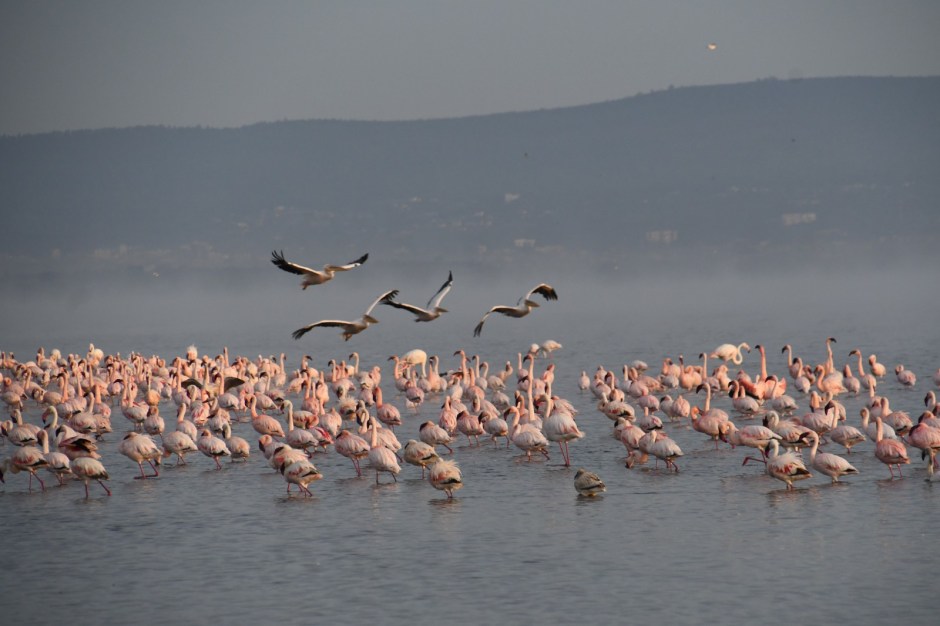
Above image: Lesser flamingoes and Great white pelicans fying overhead in Lake Nakuru National Park. Credit Inderjit Singh Mangat
Published: Saturday Nation magazine 17 Feb 2024
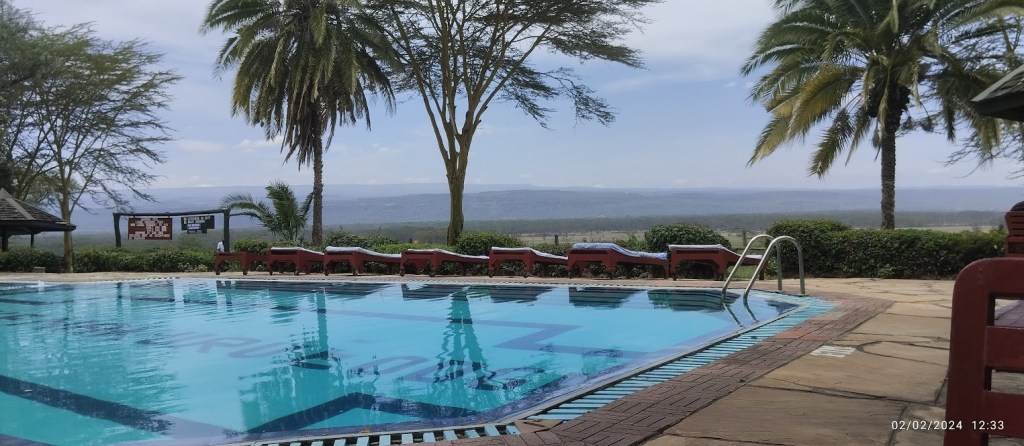
The lake is white-laced as we drive into the 100-year old farm house that morphed into Lake Nakuru Lodge. It sets the stage for the following events on a two-night stay.
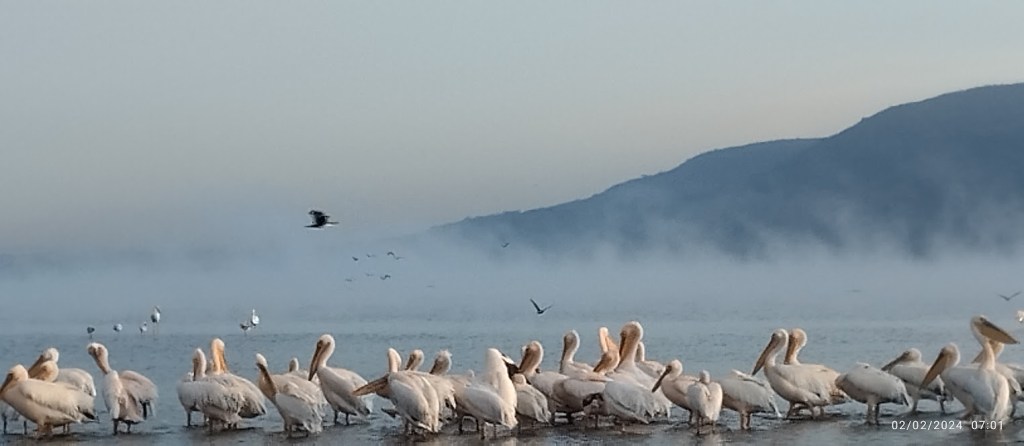
Great white pelicans at dawn with water vapor rising Lake Nakuru national park. Picture R.Mangat Feb 2024
Checked in, we’re looking the iconic lake best known for its pretty pink flamingos, the acacia woodland and the grass plains – a perfect world for all the wildlife we are about to see over a two night stay. The lake edge is laced with the Great white pelicans taking supreme advantage of the alkaline lake now turned fresh since the phenomenal rise of the Great Rift Valley lakes since 2012.
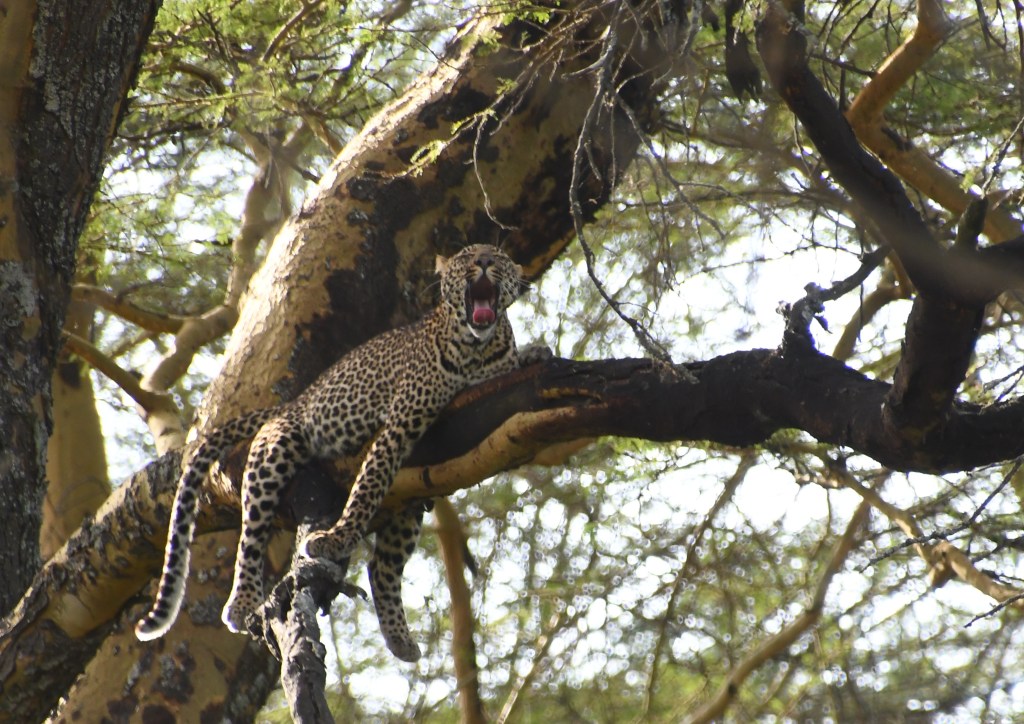
Scene one: The leopard in the tree. “You will see everything,” states Mr Muya of Lake Nakuru Lodge, who has grown up around it. The ‘everything’ includes four of the Big 5 except the elephant that is not found in the park.
Leopard lounging on acacaia in Lake Nakuru National Park Feb 2024. Credit Inderjit Mangat
Ten minutes from the lodge of day one, the leopard lounges on a thick branch of a yellow-bark acacia tree in a forested grove. The feline holds us spell-bound, stretching, yawning, turning, sitting, lying with all four limbs dangling and after an hour of suspense – will it or will it not climb down, it’s time to leave.
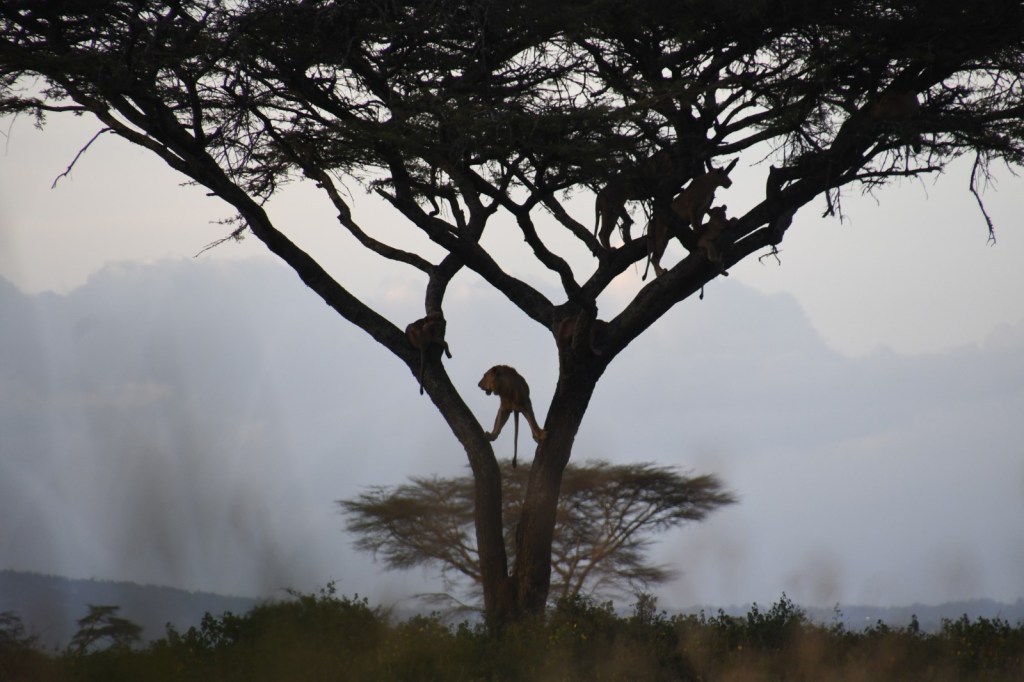
Scene two: After the leopard, same day, driving into the plains, it’s the strangest scene – a lion stuck in the tree! It’s spread-eagle with four legs apart and the tail dangling in the fork of the tree. Above it, on the higher branches are five other lions watching their mate – and on the ground, another waiting for this one to climb higher. But the poor lion can’t go any higher because the forked branches are too far apart. Is it a young dare-devil modern kid trying out new moves?
Comedy in the making – lion stuck in the fork of an acacia tree in Lake Nakuru National Park Feb 2024. Credit Inderjit Mangat
It’s straining, muscles taut. Finally some thirty minutes later, with the greatest of effort it manages to leap down safely to everyone’s relief. “The lions of Lake Nakuru climb the trees to see the best hunting ground,” tells Mr Muya. “And this pride is resident here.”
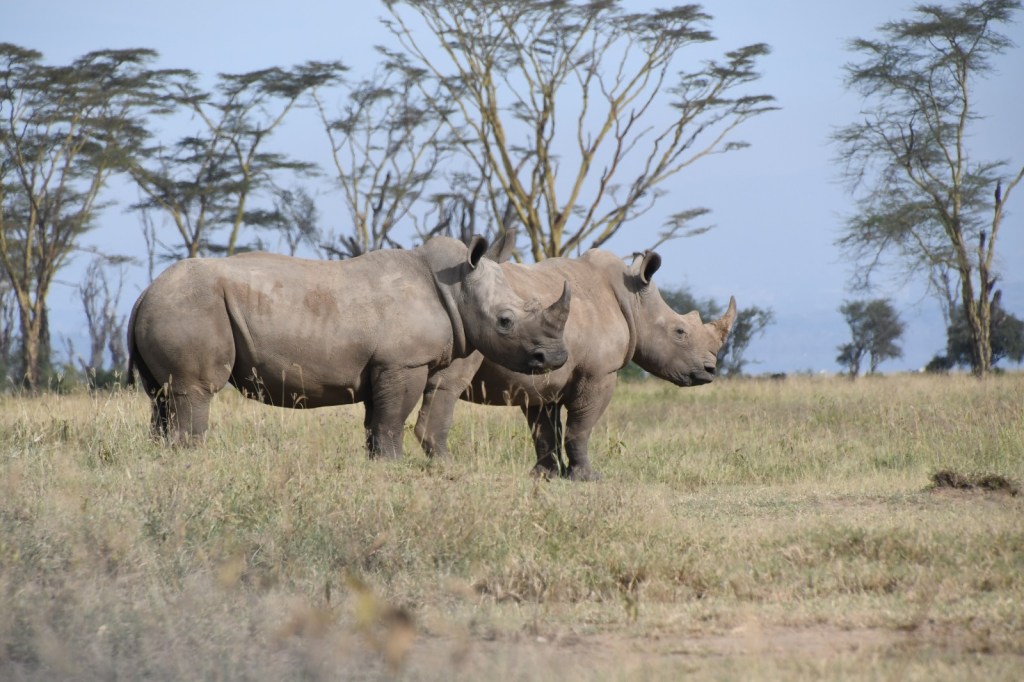
Scene three: At day break, with the piercing signature call of the African fish eagle, the family of five white rhino (the southern white which is the most common subspecies of rhino unlike the northern white that is now extinct in the wild with the last two females at Ol Pejeta Conservancy). It’s the two big females and two calves with the big male still snoozing on the ground. It’s the funniest scene. The calf decides dad has to get up. The miniature rhino bounds against the giant boulder. Dad doesn’t budge. He runs again to nudge dad up again – no luck and again – but still nothing.
White rhino family in L.Nakuru National Park. Feb 2024. Picture by Inderjit Mangat
All this would be ideal for another episode of Lion King – the real life comedy of life in the wild.
With all the drama on land, there’s more in the iconic lake that is home to over a million lesser flamingos when there is enough algae – their favourite food in the alkaline lake.
However, at this point the lake is almost fresh. Driving across Muya’s Causeway, the golden light of the morning sun fires the crimson hues of the Lesser flamingos by the salt-crusted shores, their stalky pink legs moving like ballerinas tiptoeing, busy dipping their long necks in the water to siphon the microscopic algae and plankton. It’s an engineering feat. The head in the water is upside-down, the water is sucked in, with the bird swallowing only the algae and plankton and siphoning out the salty water. For their fresh water drink, the flamingos fly a short distance to Lake Naivasha or Lake Baringo that are strung along the Great Rift.
Its colour-scope is fascinating – the pink of the flamingos the white of the pelicans, the Yellow-billed storks and African spoon bills and so many more waders while the Long-crested eagle once so common in the country finds space in the wide open plains .
Driving through the glades, herds of buffalo move like soft black waves, the gazelles and impalas gambolling, the giraffes gracefully browsing on the acacias while the baboons add more comic relief with their antics.
Lake Nakuru and its water, grasslands and open skies are home to this fascinating life on earth but for only as long as we can offer the space for the wildlife to live in and move along the migratory corridors to find new mates and breed for the next generation of healthy offspring’s.
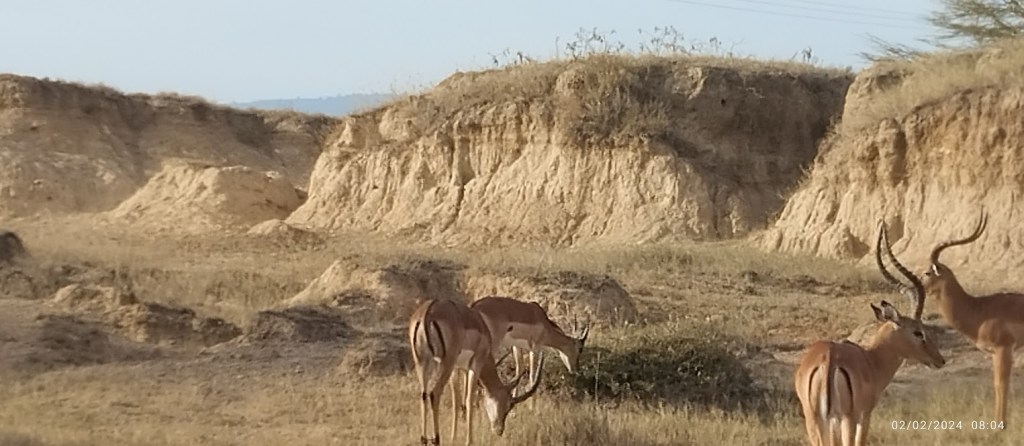
Bachelor herd of impalas at a salt lick in Lake Nakuru National Park. Pic Rupi Mangat
For now, back at the lodge, it’s time to dust off and enjoy the aromatherapy massage to rejuvenate the body and soul.
More on Lake Nakuru
Pay by e-Citizen. It can be cumbersome – it took an hour. The system needs to be more user-friendly. Once done, it’s a breeze into the parks.
Lake Nakuru Lodge and the park. Image: Rupi Mangat
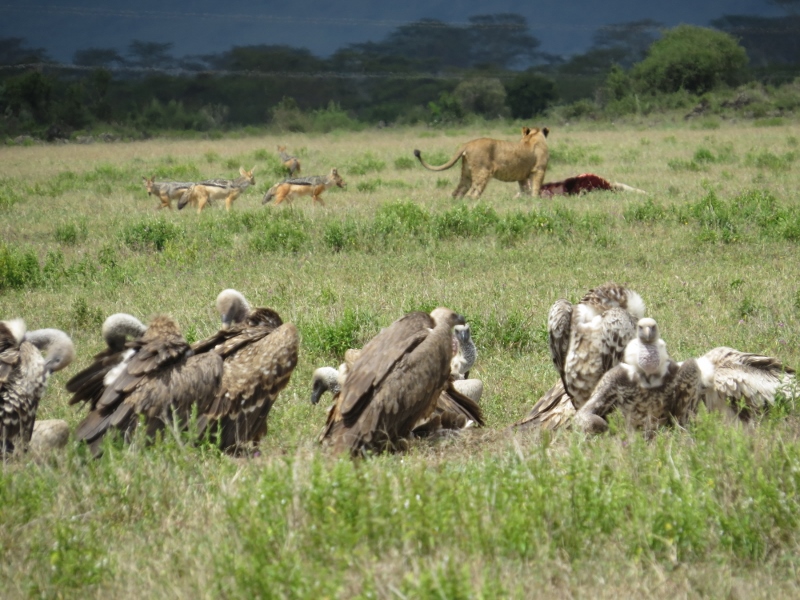
Above: Lion defending his prey from Silver-backed jackals and Ruppell’s vultures listed Critically endangered on IUCN Red List in Soysambu . By Rupi Mangat
Published: Saturday magazine 4 January 2019
A vulture circling high in the midday sky gives the first clue that there has to be something interesting on the ground. Following its wing-beat through a pair of powerful binoculars, the carrion-eater has its eye on a pride of five lions on open plain gorging on a freshly killed cow in Soysambu Conservancy bordering Lake Elmenteita in the Great Rift Valley.
The vulture that turns out to be a Ruppell’s vulture is late to arrive. On the ground there’s a flock of 70 vultures keeping a respectful distance from the lions, waiting for their turn patiently. There are three species: Ruppell’s and White-backed with a lonely Hooded one. The Hooded Vulture is smaller than the other two and keeps to the pecking order. All three species are on the IUCN Red List as Critically Endangered.
Lion feeding on cow calf by Jolai Hill oin Soysambu Conservancy in company of Silver-back jackals and vultures,. By Rupi Mangat
The Silver-backed jackals are more daring. They dart to and fro stealing bites off the carcass only to scamper when the big cat growls.
It’s like watching a wildlife documentary in real life.
Four lions stride away to a tree and slump down in the shade. For the nest two hours, the cats take turns to feed not allowing the jackals or the vultures to steal them of their kill.
Cats on the Scene
Since the early 1900s, lions hadn’t been seen in Soysambu Conservancy that once was a cattle ranch. Then in 2014 two females decided they were going to check out Soysambu and liked it and settled down. Of course they returned to the park to mate with the lion. Fliir and Valentine, the intrepid lioness then raised their cubs on Soysambu.
The pride of five is Valentine’s daughter Betty, her older two cubs and the younger pair. Fliir and Valentine are no longer around but it’s nice to see their descendants.
Suddenly the lone lion stands alert.
He’s Betty’s older son.
He’s seen two legs walking in the distance.
Lions on Soysambu. Copyright: Kat Combes copyright
“They are very afraid of two legs and white cars,” tells Rowena White monitoring the cats. Persecuted over decades by people around the lakes, the lions have a natural fear of them. White is the colour of the livestock car that chases predators away. The cats have learned that it’s best to keep away from them. The only car they trust is Rowena’s battered cream-coloured land rover and hence the reason for our gallery seats close to them.
The lions are done with the feast and move to the tree.
It’s now the turn of the vultures who completely cover the carcass chasing away the jackals. One cheeky cub returns and in a sprint chases off the vultures in a flurry of wings and flaps.
All that’s left of the carcass is gleaming bones cleaned of any flesh.
In the circle of life, vultures are the clean-up crew. In their absence, the remaining flesh on the carcass would have rotted and the stench unbearable with the fear of diseases like anthrax spreading.
Done with their feast the birds fly away.
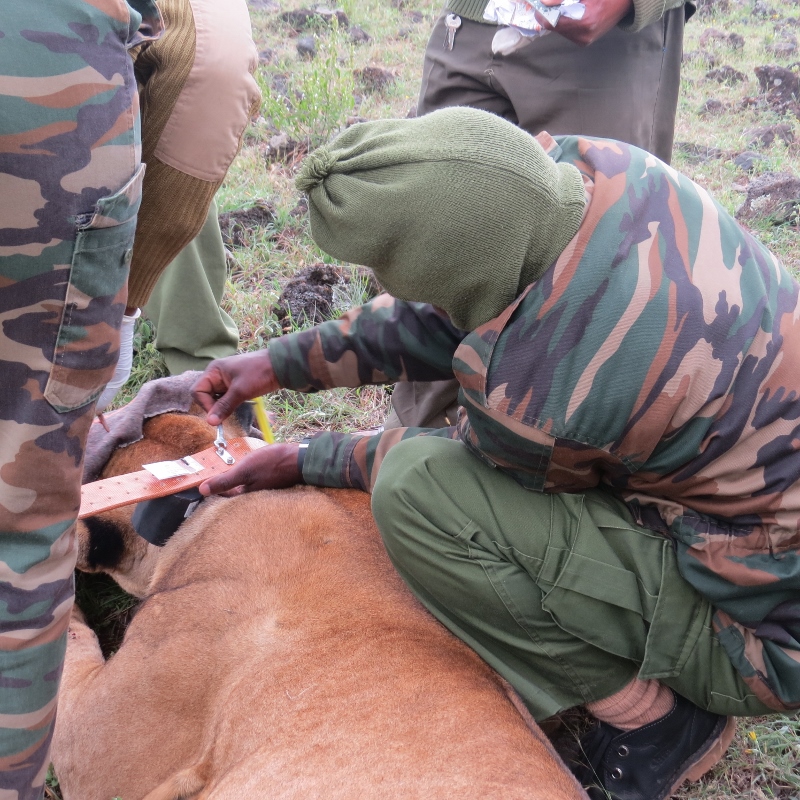
Betty is Collared
Betty being collared oin Soysambu Conservancy,. By Rupi Mangat
It’s been months of trying to dart a lion and fit a satellite collar on it. It’s to alert the cattle herders where the lions are and hence avoid the area when they take the cattle out for the morning graze. It worked with the older cats with no cattle lost to them.
The cow on the ground was unfortunate as none of these cats had been GPS collared.
With the Kenya Wildlife Service crew in the area, the vet arrives. He aims from the friendly land-rover and gets his target. It takes a few minutes for Betty to doze off while her cubs scamper away. The tranquilizer hasn’t quite taken affect and she raises her massive head to let out a roar. Everyone scampers. She’s tranquillized again and the collar fitted that will relay all her movements on the screen.
Next morning, the computer shows that at 8 p.m. the previous night as we sat on the patio, the pride had crept close and stayed at the bottom of the hill with us totally unaware.
See Soysambu
Soysambu Conservancy with Flamingos on Lake Elmenteita and Delamere’s Nose. Copyright Rupi Mangat
Soysambu Conservancy borders Lake Nakuru National Park. Part of it is in Lake Elmenteita Wildlife Sanctuary measuring 2,534 hectares.
Lake Elmenteita is a UNESCO World Heritage Site together with lakes Nakuru and Bogoria and listed as The Kenya Lakes System in the Great Rift Valley World Heritage Site because of their outstanding universal beauty, including hosting one of the richest bird life in the world
It is also a Ramsar site, a wetland of international importance; an Important Bird Area (IBA) globally recognized as a stronghold for Great White Pelicans and their only breeding site in East Africa. It is also a flamingo stronghold and an important flight-path for over a 100 species of migratory birds flying from Europe and Asia.
Soysambu Conservancy is a vital dispersal area for wildlife moving across the three lakes Nakuru-Elmenteita-Naivasha in the Great Rift Valley.
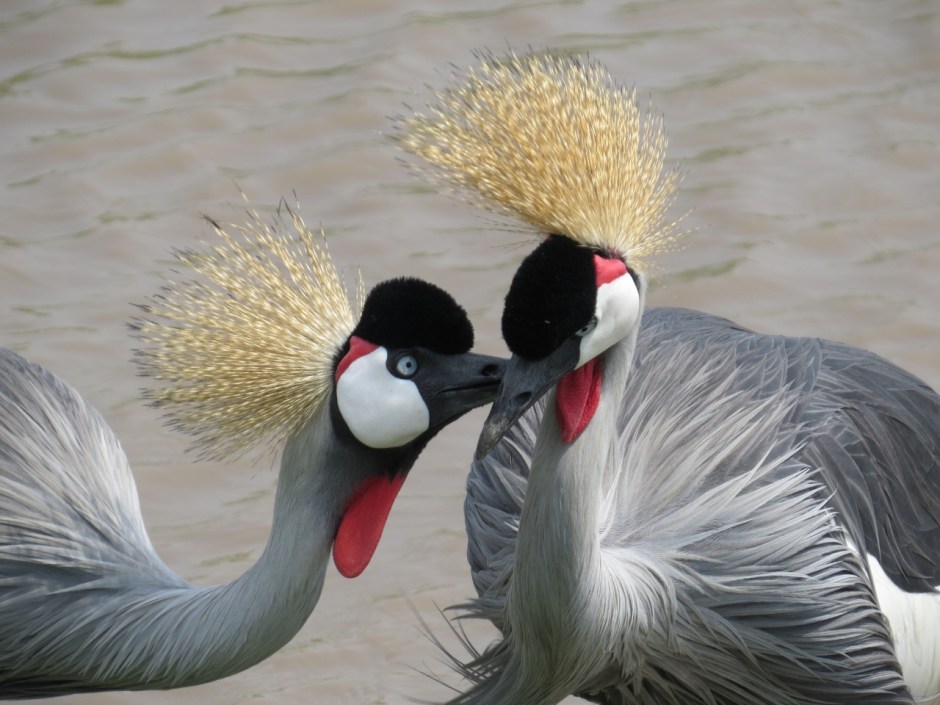
Above: Grey crowned cranes in Lake Nakuru National Park. Copyright Rupi Mangat
Published: The East African Nation media 19 to 25 October 2019
The salt ribbon around the lake has disappeared, swallowed by the rising water. It’s a phenomenon that researchers studying the lake since the first recorded data, attribute to a 50 year cycle that happened in 1901 and 1963. Continue reading “On High Water in Nakuru”→
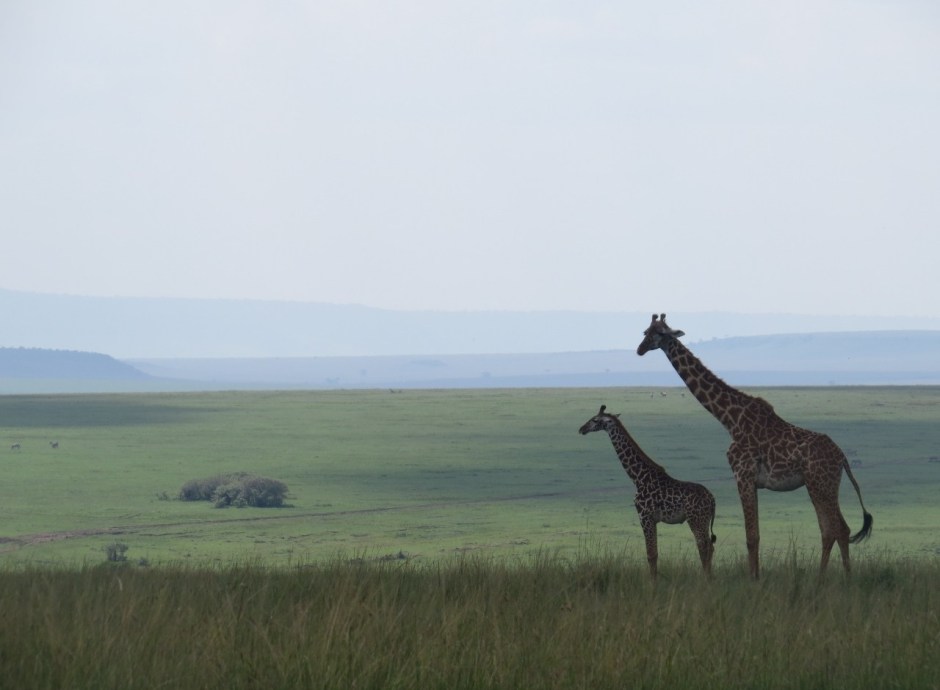
Above: Maasai giraffe, mother and calf. In Maasai Mara. Copyright Rupi Mangat
Published: 27 Juy 2019
It’s the mid-year bonanza in the Maasai Mara. It’s lush and green after a long dry spell. We’re in the south-eastern part of the 1,510-square-kilometre park that is a continuation of the 14,750-square-kilometres Serengeti National Park.
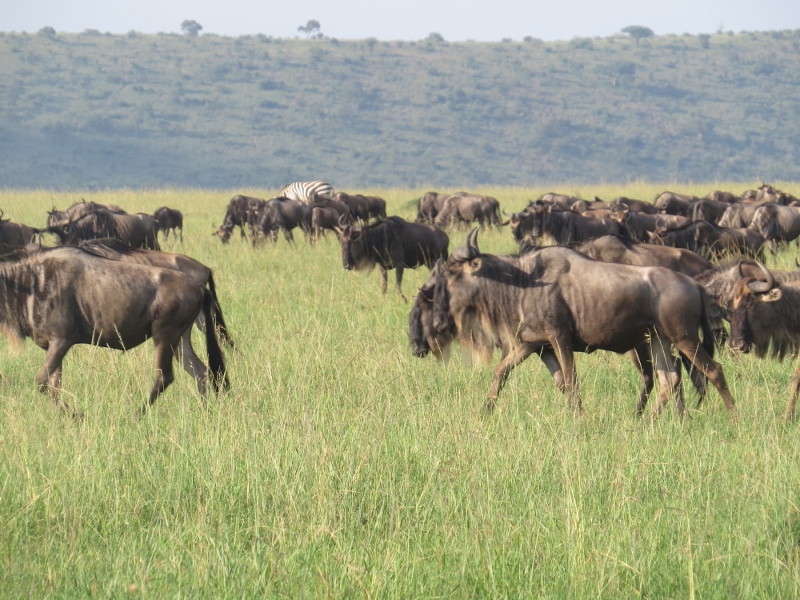
It is this enormous space that is world-famous as big game country: big for the huge herds of wildebeest, big for the big cats, big for the world’s largest land mammal – the elephant and big for the tallest – the giraffe. There are so many superlatives that describe the Mara-Serengeti ecosystem that it is mind-boggling.
June 2019 Wildebeest arriving from Serengeti into Maasai Mara. Copyright Rupi Mangat



 Moonlion Safaris