In Ancient Egypt’s royal tomb of the famous pharaoh, Tutankhamun are images of giraffes nibbling leaves while he sits in state some 3000 years ago. Giraffes and elephants including the rare okapi lived in the midst of the Egyptians until the forests were plundered to build boats and pyramids for the pharaohs, which heralded in the Saharan Sands.
Giraffes have globe trotted the earth since the Miocene era 23 million years ago when their range included Europe and Asia.
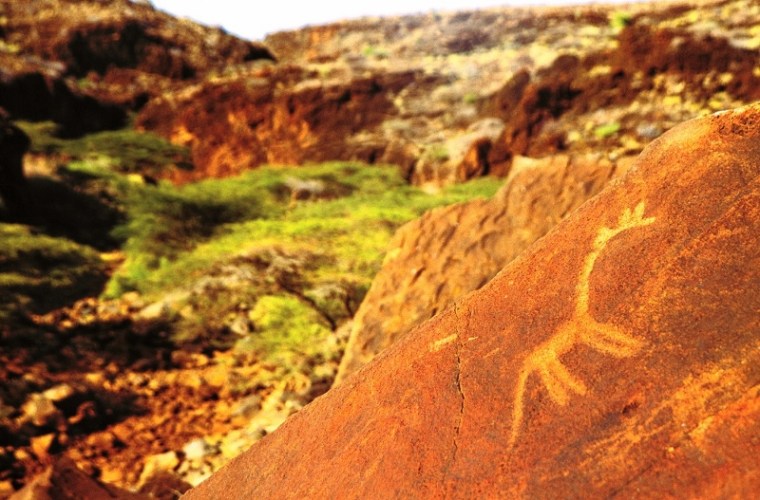
Engraving of giraffe in Afgaba gorge northern Kenya made around a thousand years ago by hunter gatherers who might have been Batwa.. Copyright David Coulson of Trust for African Rock Art TARA
“Giraffes appear more frequently than most other animals on rock art,” states David Coulson of the Trust for Africa Rock Art (TARA) that is a digital repository of Africa’s most important prehistoric rock art. “It is the earliest artistic expressions of humankind, a window on how our ancestors related and interacted with nature and the natural world,” continues Coulson.
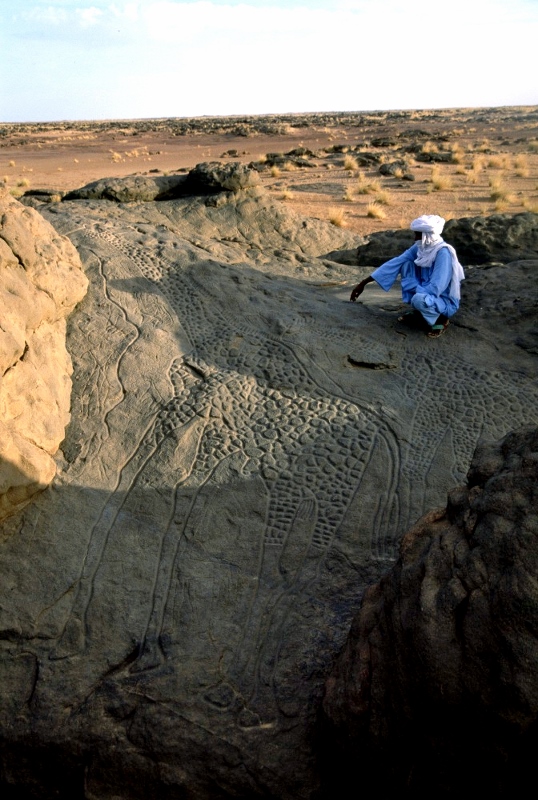
A Tuareg man by a 6,000 year life size engraving of giraffes in Niger. Copyright David Coulson of Trust for African Rock Art TARA
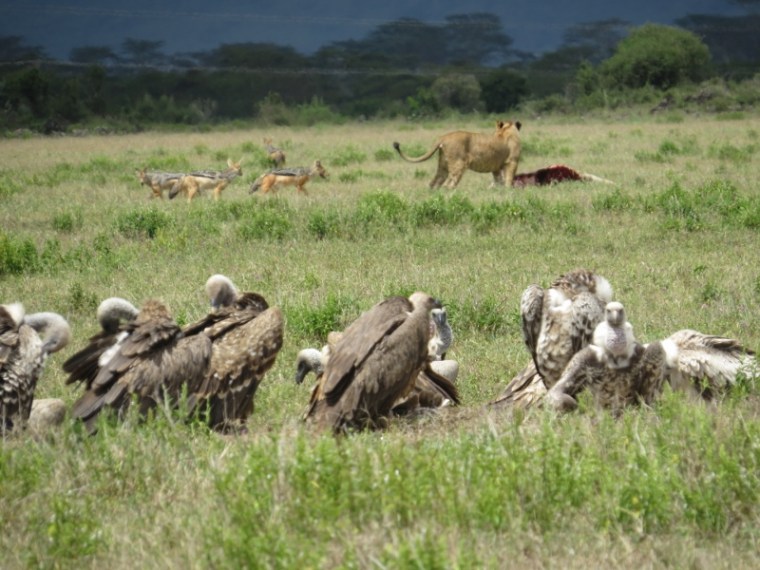
Above: Lion defending his prey from Silver-backed jackals and Ruppell’s vultures listed Critically endangered on IUCN Red List in Soysambu . By Rupi Mangat
Published: Saturday magazine 4 January 2019
A vulture circling high in the midday sky gives the first clue that there has to be something interesting on the ground. Following its wing-beat through a pair of powerful binoculars, the carrion-eater has its eye on a pride of five lions on open plain gorging on a freshly killed cow in Soysambu Conservancy bordering Lake Elmenteita in the Great Rift Valley.
The vulture that turns out to be a Ruppell’s vulture is late to arrive. On the ground there’s a flock of 70 vultures keeping a respectful distance from the lions, waiting for their turn patiently. There are three species: Ruppell’s and White-backed with a lonely Hooded one. The Hooded Vulture is smaller than the other two and keeps to the pecking order. All three species are on the IUCN Red List as Critically Endangered.
Lion feeding on cow calf by Jolai Hill oin Soysambu Conservancy in company of Silver-back jackals and vultures,. By Rupi Mangat
The Silver-backed jackals are more daring. They dart to and fro stealing bites off the carcass only to scamper when the big cat growls.
It’s like watching a wildlife documentary in real life.
Four lions stride away to a tree and slump down in the shade. For the nest two hours, the cats take turns to feed not allowing the jackals or the vultures to steal them of their kill.
Cats on the Scene
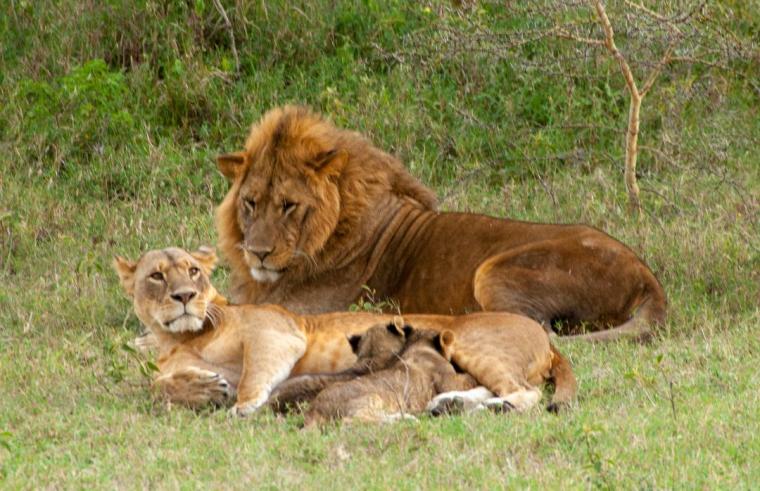
Since the early 1900s, lions hadn’t been seen in Soysambu Conservancy that once was a cattle ranch. Then in 2014 two females decided they were going to check out Soysambu and liked it and settled down. Of course they returned to the park to mate with the lion. Fliir and Valentine, the intrepid lioness then raised their cubs on Soysambu.
The pride of five is Valentine’s daughter Betty, her older two cubs and the younger pair. Fliir and Valentine are no longer around but it’s nice to see their descendants.
Suddenly the lone lion stands alert.
He’s Betty’s older son.
He’s seen two legs walking in the distance.
Lions on Soysambu. Copyright: Kat Combes copyright
“They are very afraid of two legs and white cars,” tells Rowena White monitoring the cats. Persecuted over decades by people around the lakes, the lions have a natural fear of them. White is the colour of the livestock car that chases predators away. The cats have learned that it’s best to keep away from them. The only car they trust is Rowena’s battered cream-coloured land rover and hence the reason for our gallery seats close to them.
The lions are done with the feast and move to the tree.
It’s now the turn of the vultures who completely cover the carcass chasing away the jackals. One cheeky cub returns and in a sprint chases off the vultures in a flurry of wings and flaps.
All that’s left of the carcass is gleaming bones cleaned of any flesh.
In the circle of life, vultures are the clean-up crew. In their absence, the remaining flesh on the carcass would have rotted and the stench unbearable with the fear of diseases like anthrax spreading.
Done with their feast the birds fly away.
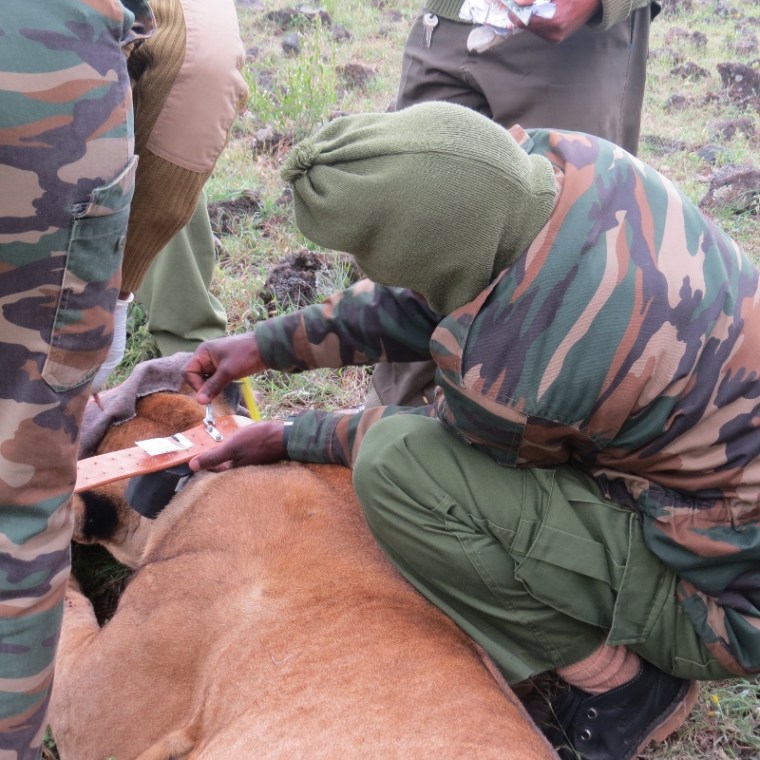
Betty is Collared
Betty being collared oin Soysambu Conservancy,. By Rupi Mangat
It’s been months of trying to dart a lion and fit a satellite collar on it. It’s to alert the cattle herders where the lions are and hence avoid the area when they take the cattle out for the morning graze. It worked with the older cats with no cattle lost to them.
The cow on the ground was unfortunate as none of these cats had been GPS collared.
With the Kenya Wildlife Service crew in the area, the vet arrives. He aims from the friendly land-rover and gets his target. It takes a few minutes for Betty to doze off while her cubs scamper away. The tranquilizer hasn’t quite taken affect and she raises her massive head to let out a roar. Everyone scampers. She’s tranquillized again and the collar fitted that will relay all her movements on the screen.
Next morning, the computer shows that at 8 p.m. the previous night as we sat on the patio, the pride had crept close and stayed at the bottom of the hill with us totally unaware.
See Soysambu
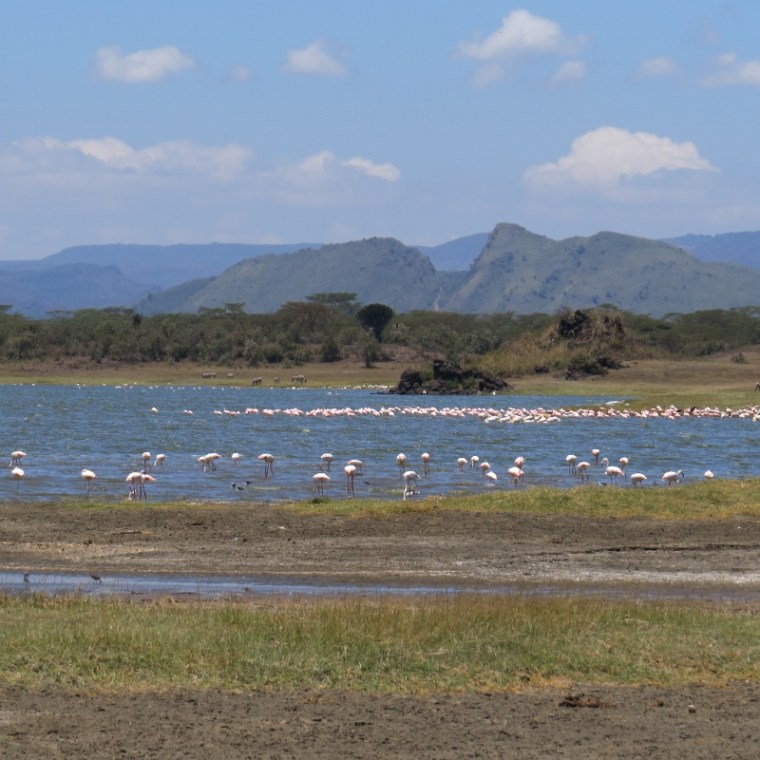
Soysambu Conservancy with Flamingos on Lake Elmenteita and Delamere’s Nose. Copyright Rupi Mangat
Soysambu Conservancy borders Lake Nakuru National Park. Part of it is in Lake Elmenteita Wildlife Sanctuary measuring 2,534 hectares.
Lake Elmenteita is a UNESCO World Heritage Site together with lakes Nakuru and Bogoria and listed as The Kenya Lakes System in the Great Rift Valley World Heritage Site because of their outstanding universal beauty, including hosting one of the richest bird life in the world
It is also a Ramsar site, a wetland of international importance; an Important Bird Area (IBA) globally recognized as a stronghold for Great White Pelicans and their only breeding site in East Africa. It is also a flamingo stronghold and an important flight-path for over a 100 species of migratory birds flying from Europe and Asia.
Soysambu Conservancy is a vital dispersal area for wildlife moving across the three lakes Nakuru-Elmenteita-Naivasha in the Great Rift Valley.
A new study shows increasing danger that roads pose to wildlife
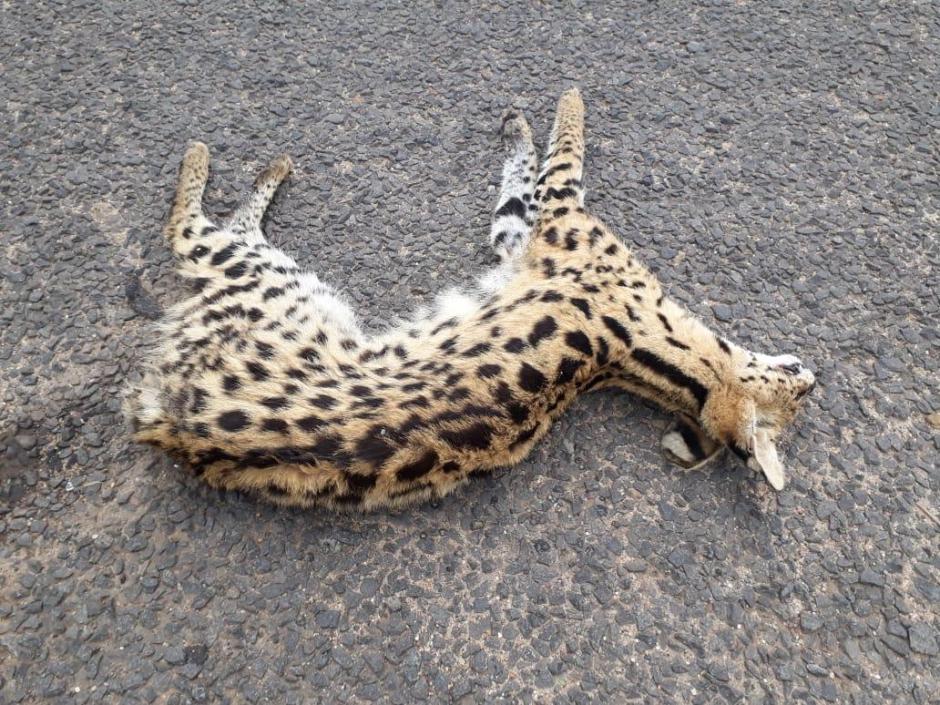
Above: Serval hit on Mombasa Highway near Kapiti Estate 24th November 2019. Cortesy Mary Wykstra Action for Cheetahs Kenya
Published: Business Daily, Nation media 7 January 2020
For five months Peter Kibobi woke every morning to span a section of the Mombasa-Nairobi highway to check on wild and domestic animals killed on the road, knocked down by vehicles. “There was not a single day that went without recording any deaths,” tells the young researcher working on his Master’s degree in wildlife management.
He recorded rare animals like aardvark, serval, snakes, zebra, tortoises, gazelles, birds…the list could go on.
Published: The East African Nation media 26 October 2019
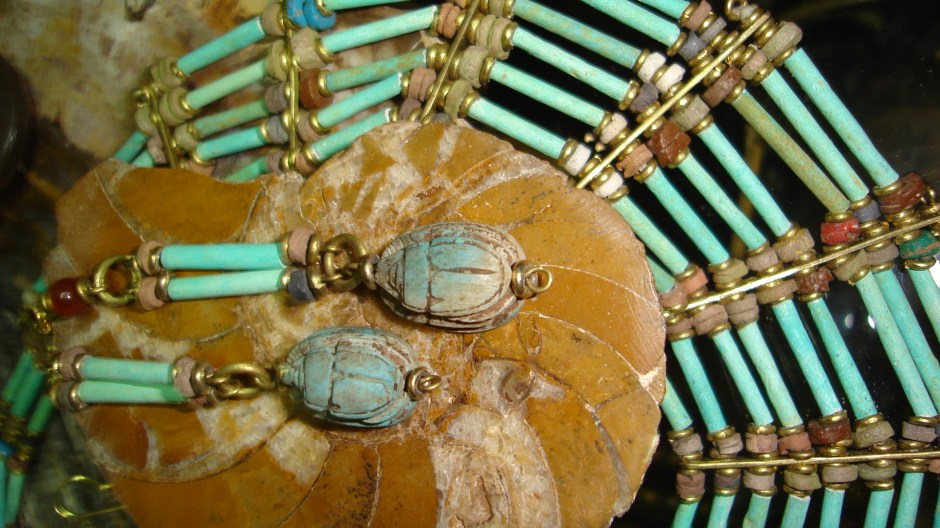
I stared at myself in the mirror, transfixed and let out an audible gasp. The beaded collar copied from the Egyptian queen dating more than 4,500 years, adorning my skin was the single most beautiful thing l had ever worn. It held me mesmerized, entrenched and enchanted me into the world of beads, that l had until hereto little interest in.
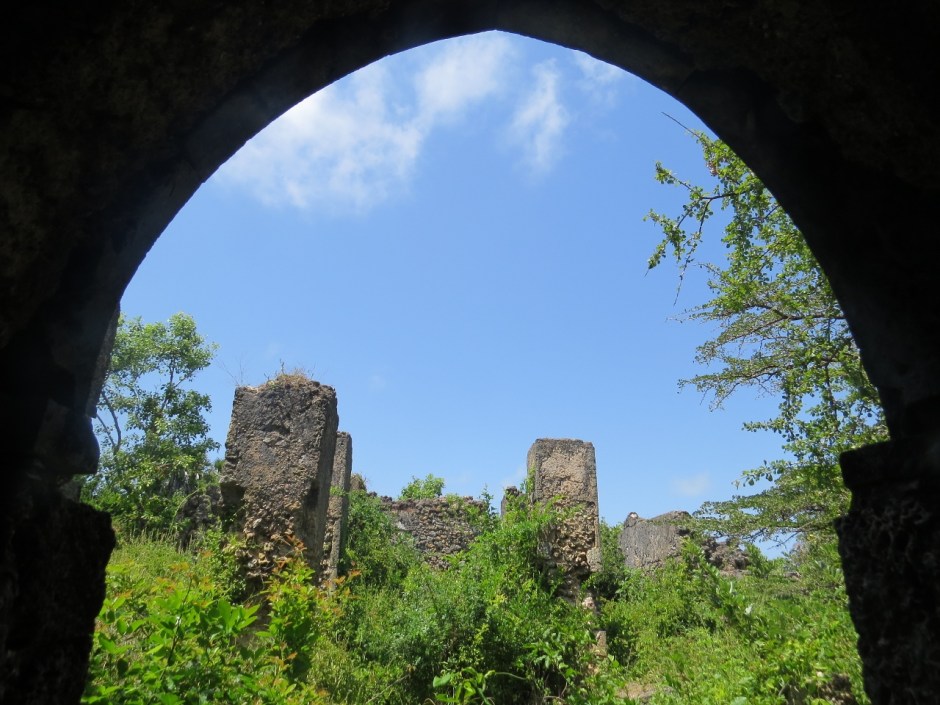
Above: From the arch of the mosque near Fumo Liyogo’s grave near Kipini on the tip of Tana Delta – Rupi Mangat
Published: Saturday Nation magazine 16 November 2019
It’s a quiet brook at Kalota on the tip of the delta that is Kenya’s largest, the Tana. It’s here we hop on to the boat belonging to the Ozi Community Conservation Area that is supported by Nature Kenya, the country oldest natural history society started in 1909 by like-minded naturalist.

 Moonlion Safaris