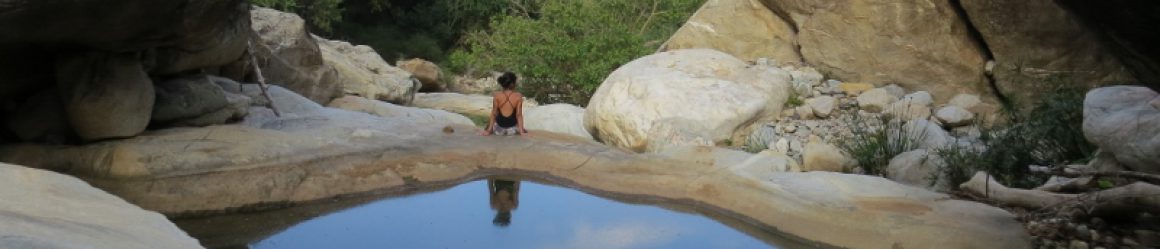
A dry lake bed catches the eye near Iremeto Gate into Amboseli National Park off the Emali Road. On a whim, we decide to take a walk over the small hill to the dry pan that looks similar to the dry Lake Amboseli inside the park in the shadow of Kilimanjaro.
Months-old dry elephant dung near a waterless lake outside Amboseli National Park Copyright Maya Mangat
On the trail of the elephant dung Copyright Maya Mangat
To the dry lake bed outside Amboseli National Park Copyright Maya Mangat
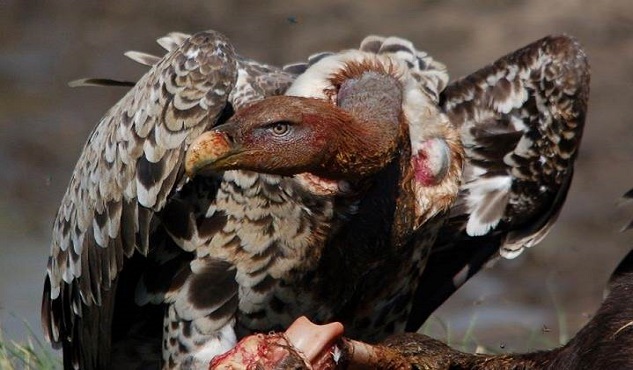
Rüppell’s Vultures are the marathon runners of the sky. They soar over huge distances to find their favourite meal of carrion. When they arrive at a carcass, often together with White-backed vultures, they can strip a carcass bare in a matter of minutes. They are such highly-evolved scavengers that no other animal can match their efficient removal of flesh from a carcass. This means that without Rüppell’s and other vultures, carcasses can lie uneaten for days, and there is a much greater chance of the spread of disease.
White backed vulture Copyright Tui De Roy
White backed vultures at carcass Copyright Tui De Roy
Over the last 30 years Rüppell’s Vultures have disappeared from the skies of East Africa. Although they can still be seen in most game parks, their numbers have declined dramatically due to poisoning. Poisons are often used by pastoralists to kill predators, such as lions and hyenas that have attacked livestock. Rüppell’s and other vulture species are the unintentional victims of such poisonings because they often arrive first at carcasses and in large numbers.
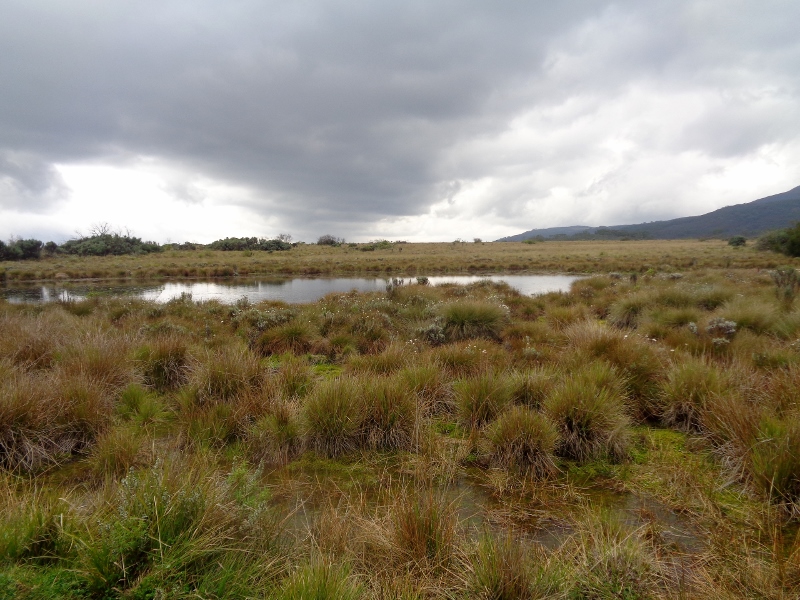
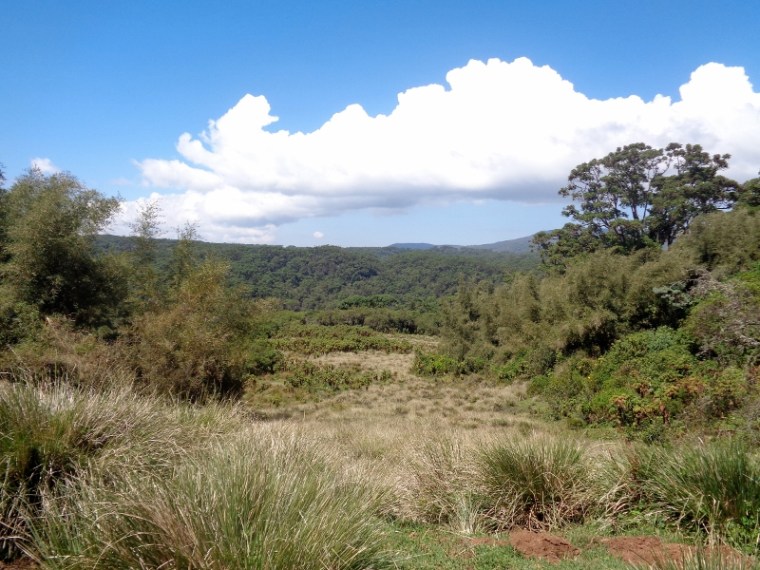
The high moorland of the Aberdares Copyright Rupi Mangat
The slippery high road to the moors of the Aberdares is stunning through thick groves of bamboo forest giving way to the hagenia forest that’s also known as rosewood on higher slopes. The colours of the forests are rich and lush – the luxuriant green of the thick moss on the fat branches of the hagenia and the wispy tails of the hanging lichens in the fresh, clean air of the mountains. At this high altitude, forest ferns and giant lobelia compete for space with Red-hot pokers breaking though the many shades of green. I’m eager to see the Mountain Bongo – one of Kenya’s rarest antelopes but the antelope with ivory-tipped horns doesn’t dash out of the forest like it did a decade ago.
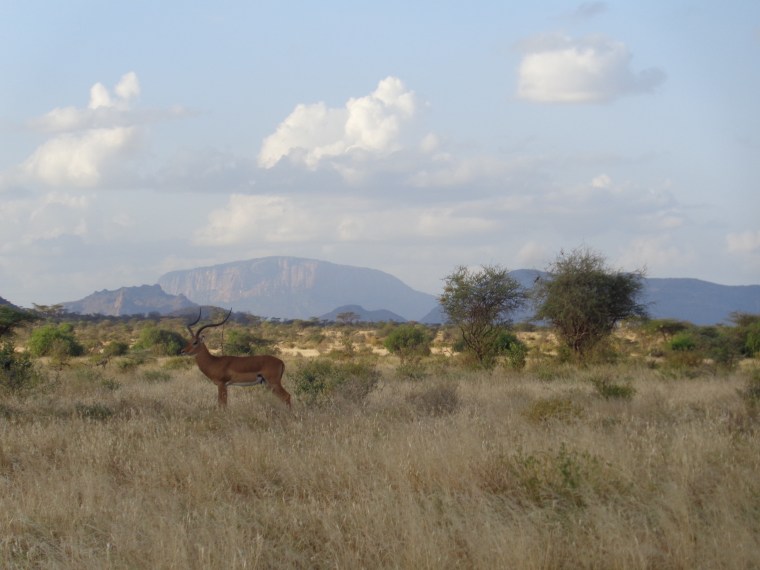
Male impala in Samburu National Reserve with the iconic bread basket – Ololokwe in the background
A trio of giraffe browses on the thorn trees on a plain of sun-burnished grass in the dry season. The sand-bottom luggas run dry except for the Ewaso Nyiro flowing its way through the reserve, providing the only water for the animals.
John Doherty of the Reticulated Giraffe Project knows the giraffes by sight. “Their names are written on their skins,” he says. “There’s Tailess, Finger and Mermaid’s Purse.”
We’re not even that close to see the details but Doherty knows almost all the 500 Reticulated giraffes that wander in and out of Samburu National Reserve by sight.
Born with an innate fascination for animals, Doherty started the Reticulated Giraffe Project while studying for his PhD in the reserve a decade ago.
“They are three bulls,” he continues as we drive closer. Looking through our binoculars, it’s easy to identify Tailess – he has no tail – probably bitten off by a big cat. Finger’s white markings on the neck don’t quite go all the way to the mane but look like fingers clasping his neck. It’s easy to see why Doherty says their names are written on their skins.
However these are just nick-names – including names given by the local tribes like the Gabbra and Samburu. “Many name a giraffe in memory of their ancestor,” tells Doherty.
All the Reticulated giraffes of the north-eastern territory that the project covers are identified by using a pattern-recognition software where both sides of the giraffe are photographed.
Once Common
Giraffes once covered the savannah grasslands of Africa. Nobody thought they would go out of fashion.
But in the last decade, some 30% may have been lost due to habitat loss and poaching. Kenya is the only country with the most giraffe species – the Rothschild, Maasai and Reticulated.
Reticulated giraffe numbers have crashed by more than 80% – from about 30,000 a decade ago to fewer than 5,000 today. Their stronghold is north-eastern Kenya and some isolated populations in Somalia.
“This year we plan to put GPS collars on six to understand their movement patterns,” continues Doherty. “It’s important because of the projects like LAPSSET (Lamu Port Sotuth Sudan Ethiopia Transport road). We need to have mitigation measures put in place.”
Already the new tarmac road from Isiolo to Moyale is claiming lives with fast-moving vehicles like the pregnant Reticulated giraffe crossing from Samburu into Shaba National Reserve. A vehicle smashed into her legs killing her instantly and her unborn baby.
Doherty has many tales to tell of the giraffes being monitored. A few weeks ago, a new born calf was splashing around in the Ewaso Nyiro with its mother. Then came the croc and snapped it – and this was happening as Doherty, his assistant and guests watched. For 30 minutes the foal struggled as the pair got washed down stream.
“We thought the foal was gone,” says Doherty. Then two hours later came a call from a Samburu ranger called Lesil who fought off the croc and saved the foal. Check it out on http://www.reticulatedgiraffeproject.net/RGP/TWIGA.html. Understandably, the foal’s been named Lucky.
In the cool of the day, we return to Samburu Intrepids Camp – for regulations demand no night-driving. We miss the leopard with her cub but spot elephants and a sandgrouse, a beautiful bird that soaks itself in water in this arid land and flies back to the chicks with drenched feathers. The chicks then suck on them.
Gerenuks stand on their hind legs to browse on the higher branches – the only antelope that does so. Nicknamed the giraffe-antelope (Swala-twiga in Kiswahili) this russet coloured antelope has a long neck and is found in the northern region.
We’ve had two days searching for the rare Grevy’s zebra and only seen one during the Great Grevy’s Zebra Rally 2016.
It’s Murphy’s law.
Just as we are leaving Samburu National Reserve, a herd of three females with four foals emerge. Females with foals need water every day – and the Ewaso Nyiro provides them with it.
Samburu National Reserve
It’s 350 north – the road is tarmac all the way to Archer’s Post near the gate. Please carry your ID cards. Check with tour agent for current entry rates.
Samburu Intrepids Camp www.heritage-eastafrica.com is on the banks of the Ewaso Nyiro River. It’s got beautiful luxury tents including enormous family tents with lots for children to do.
In Westgate Conservancy bordering Samburu National Reserve
Driving through Samburu National Reserve to get to the community-owned Westgate Conservancy, the first animal to bolt across the road in the mid-afternoon heat – is a Grevy’s zebra.
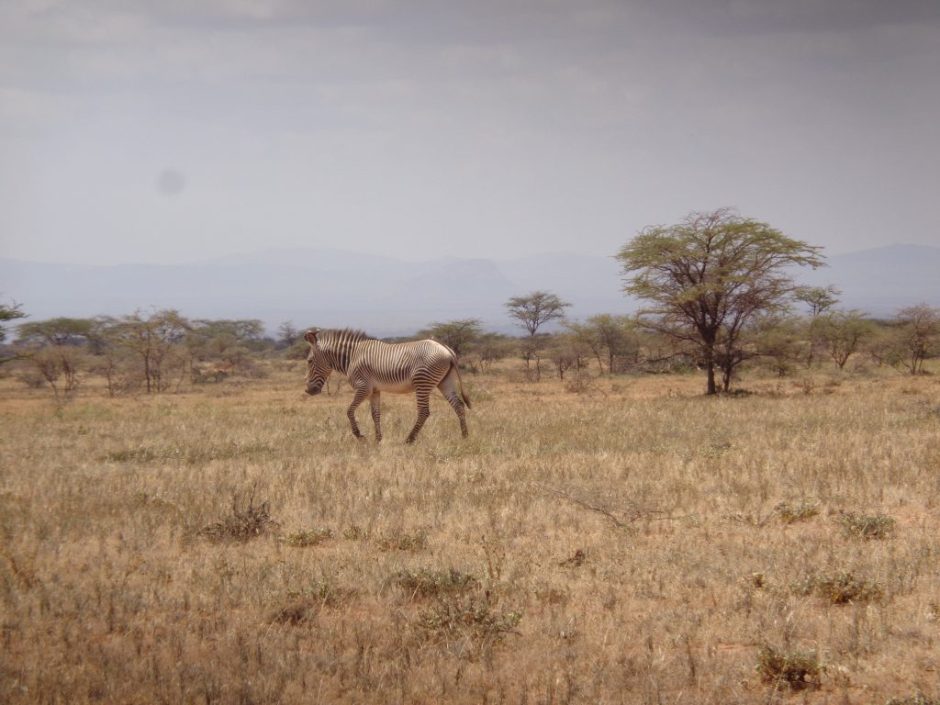
Lone Grevy’s zebra heading towards Mathews Range
Amazing landscape
Termite mound in Westgate Conservancy
The Ewaso Nyiro River – the only source f water in the Samburu wilderness as seen from Westgate Conservancy
But we cannot at this point shoot it – that is shoot it with a camera and not a gun (a gun would mean a fine of up to Ksh 20 million or time spent behind bars under the new Wildlife Act 2015).








 Moonlion Safaris