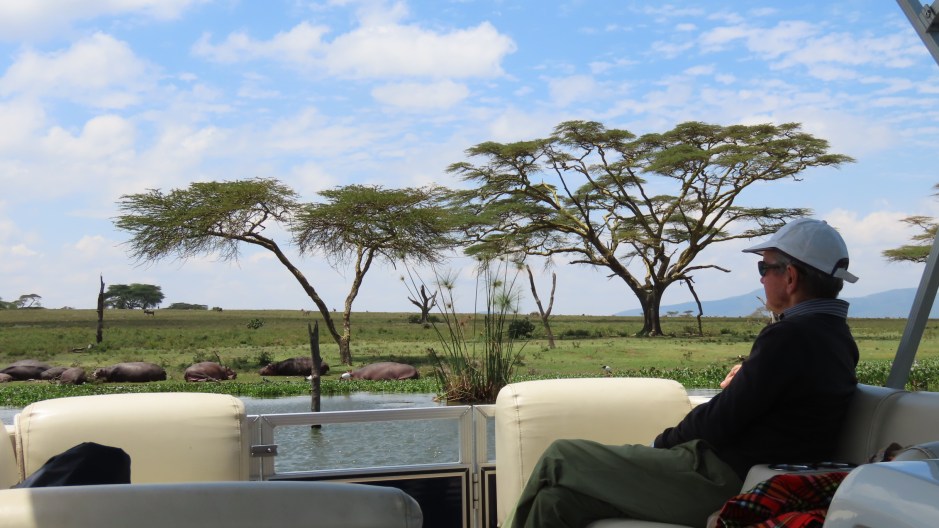
Above: Sailing on Angel’s Ark on Lake Naivasha to Crescent Island. Credit Bonnie Dunbar
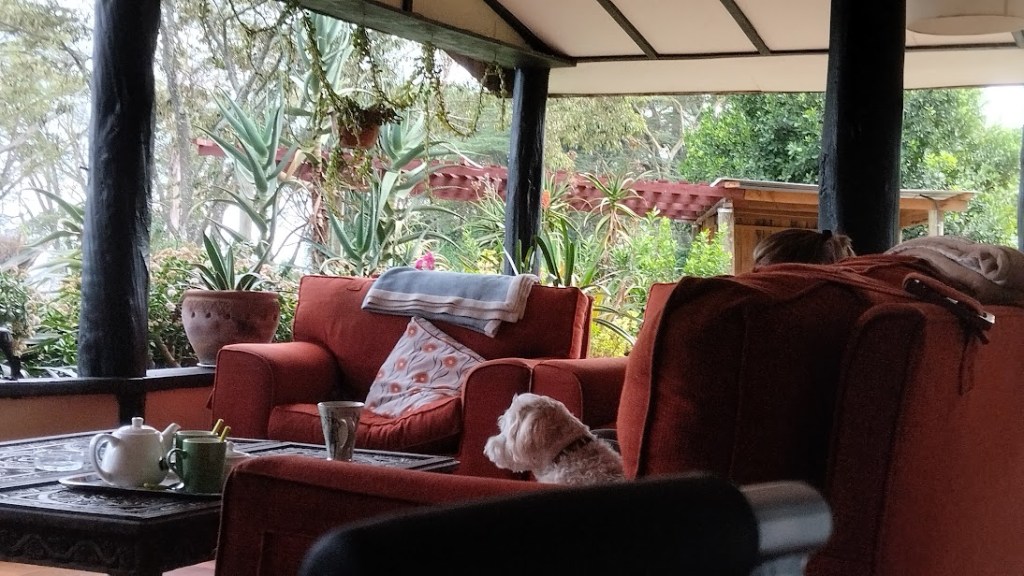
The house is legendary as is the lake on whose shores it rests. Kilimandege – the hill of the birds has seen many novel visitors, chief amongst them Sally the hippo who wandered through the doors to sit in the lounge. The white-washed house was home to the famous couple Alan and Joan Root who shot some of the first epic movies on wildlife like the unforgettable Mysterious Castles of Clay and Mzima, Portrait of a Spring.
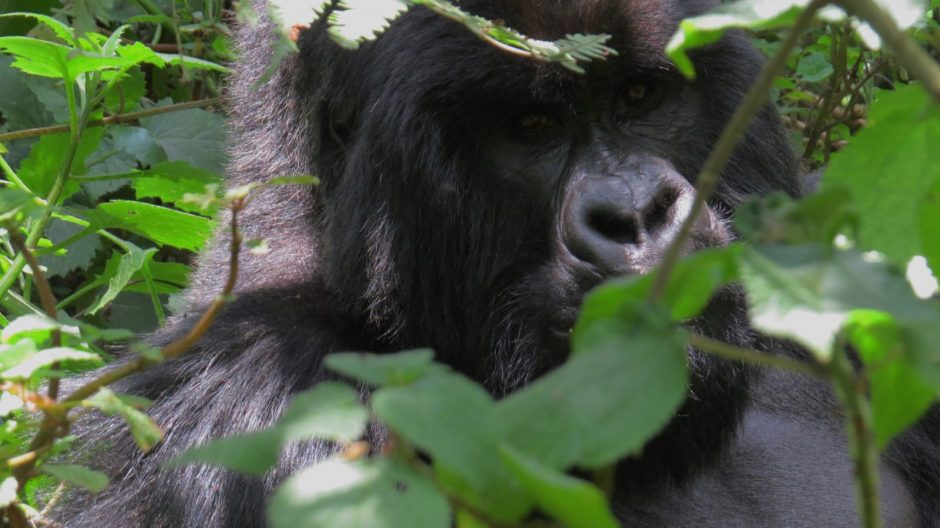
In the stillness of the forest, the silence is interrupted by the sound of snapping branches. “It’s the forest elephants moving through the forest,” tells Chelimo Salim in a quiet tone. He’s our gorilla guide on the trek to see the greatest ape on the planet – the gorilla and to be specific, the Mountain gorillas of Bwindi.
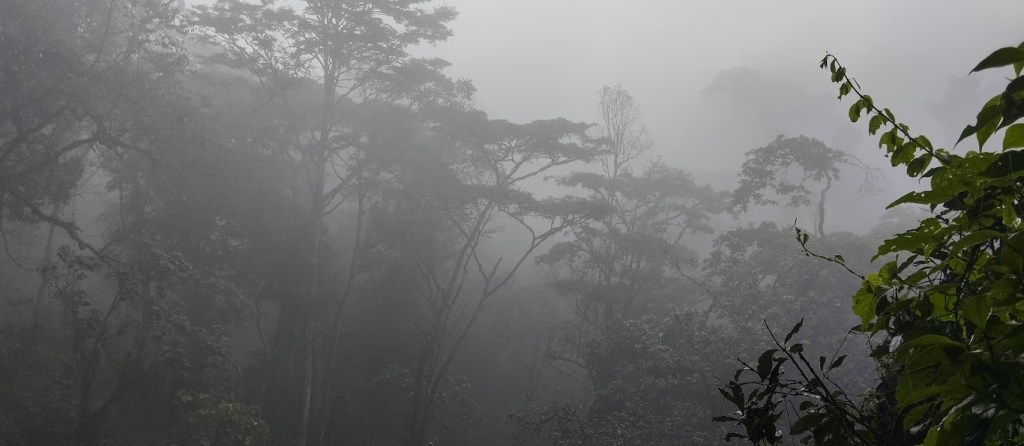
The morning mist is rising to reveal the dense forest covering the mountain range of the Virunga volcanoes that stretch into neighbouring Rwanda that is also home to these gorillas.
But at this moment I want to see the unique forest elephants that are rare and adapted to living in the dark, dense forests of Bwindi. Smaller than the African savannah elephants, they have rounded ears and straighter downward pointing tusks which make it easier for them to move through the forest. It’s anybody’s guess how many there are in the forest – estimates waver between 40 and 300.
The sound ebbs as the elephants move deeper into the impenetrable forest that few outsiders knew about until recently. Its sudden claim to fame came with the ‘discovery’ of the Mountain gorillas – and that not even by sight but from their droppings below their night nests when researchers began to venture into the thick forest glades. That was in the 1980s when Uganda was in the midst of political turmoil. Needless to say, this ‘discovery’ made little headlines.
FYI – Bwindi means place of darkness from the Runyakitara word Mubwindi.
Meet the mighty river on its most dramatic stage where it plunges 43 metres on its journey north to drain into the Mediterranean. By RUPI MANGAT
Published: Nation media Sarmag 9 August 2025
The great expanse of water shimmers in the morning light as we fly over it to land in Entebbe, an hour’s flight from Nairobi. Yet less than two hundred years ago, the outside world knew nothing about this lake or the country that we now know of as Uganda.
Back then, Africa’s interior was a closely guarded secret by the Arab traders mainly for slaves, elephant tusks and timber. The mystery of the Nile’s origin became the driving force for the European explorers to enter the unknown. So when John Hanning Speke saw the lake in 1858 from a village near Mwanza in Tanzania, he uttered the unforgettable quote, “The Nile is solved”. He was ridiculed for it. The matter of the Nile was finally solved in 1875 when the journalist-explorer Henry Morten Stanley circumvented Victoria (as Speke christened it after the then British monarch, Queen Victoria), confirming it as the Nile’s source.
From Entebbe to the world’s most powerful falls
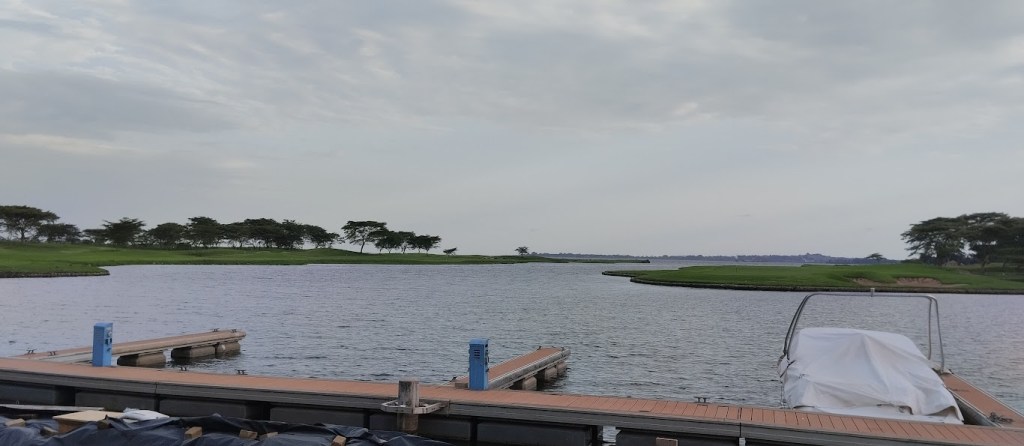
The Marina and jetty by the golf course on Lake Victoria at Lake Victoria Serena, Entebbe, Uganda. Image: Rupi Mangat
We’re wrapped in luxury at Lake Victoria Serena Entebbe on the edge of the Great African lake. Our journey into Uganda is to scale the mountains of the impenetrable forest in search of Bwindi’s Mountain gorillas that the outside world only got to know of in 1987 – and that not even by sighting our ape cousins but from the droppings below their night nests.
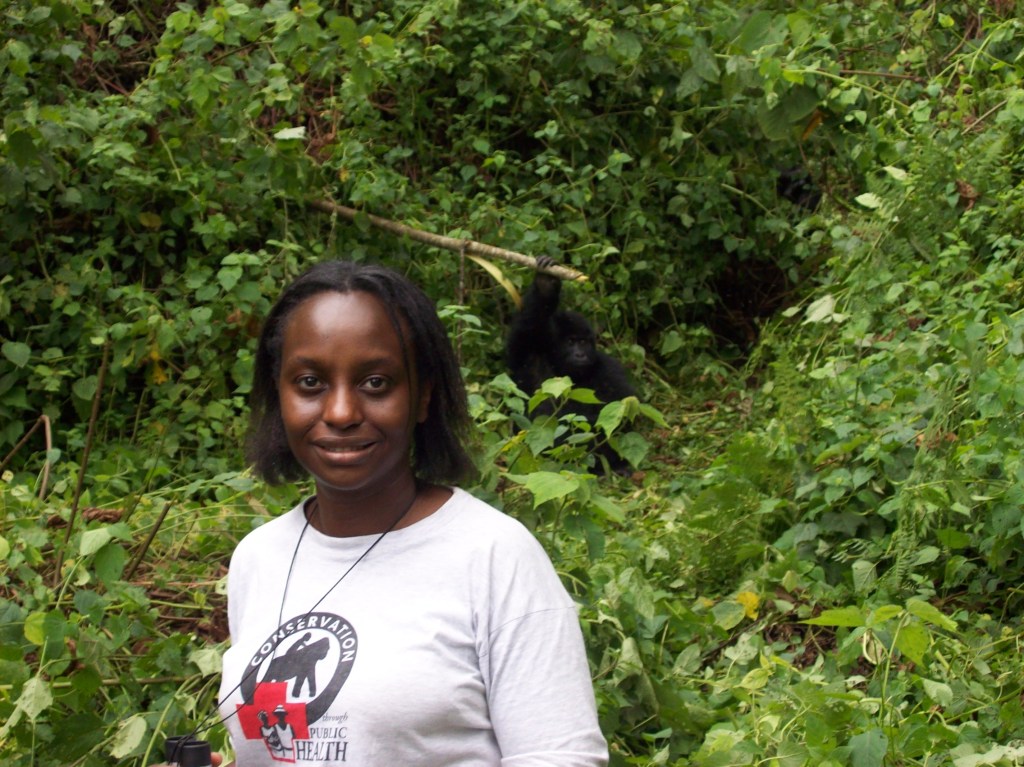
“The Mountain gorilla is the only subspecies of gorillas that is increasing in number and is now classified as ‘endangered’ from ‘Critically endangered’,” states Dr Gladys Kalema-Zikusoka, Uganda’s first wildlife vet. Their numbers have increased from an estimated 300 to 1063 in the wild today.
Dr. Glady Kalema-Zikusoka , Uganda’s first wildlife vet and founder of Conservation Through Public Health
Dr Gladys is a trail blazer. She and her husband Lawrence founded Conservation Through Public Health (CTPH) 20 years ago and have achieved international recognition for their ‘One Health’ approach that involves the well-being of the people who live alongside our ape cousin. Dr Gladys’ book, ‘Walking with Gorillas’ is a best seller, copies of which she signs after her presentation to the enraptured group.
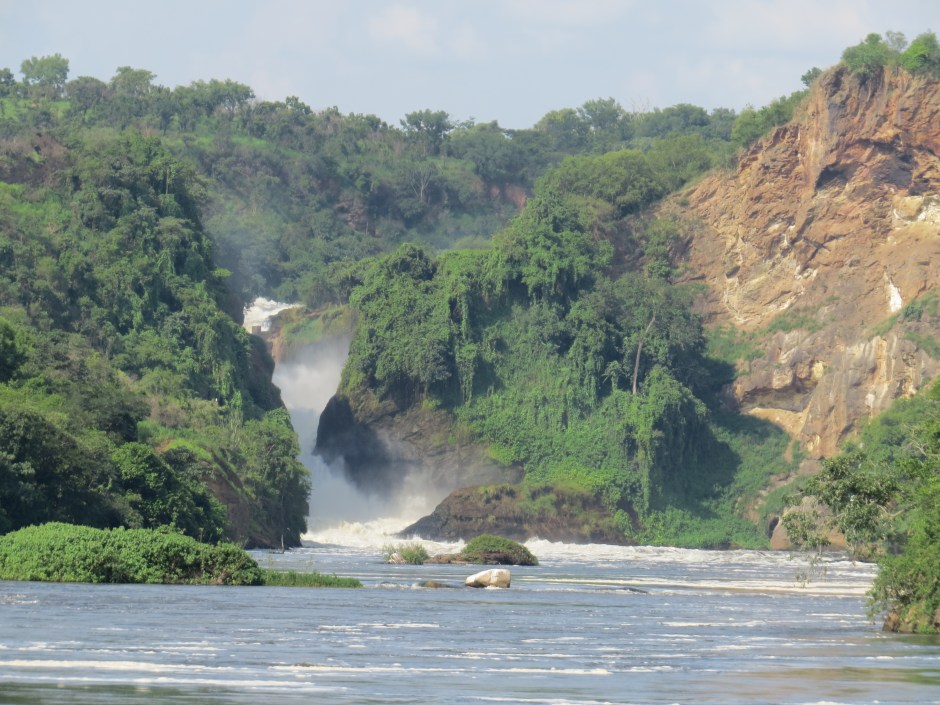
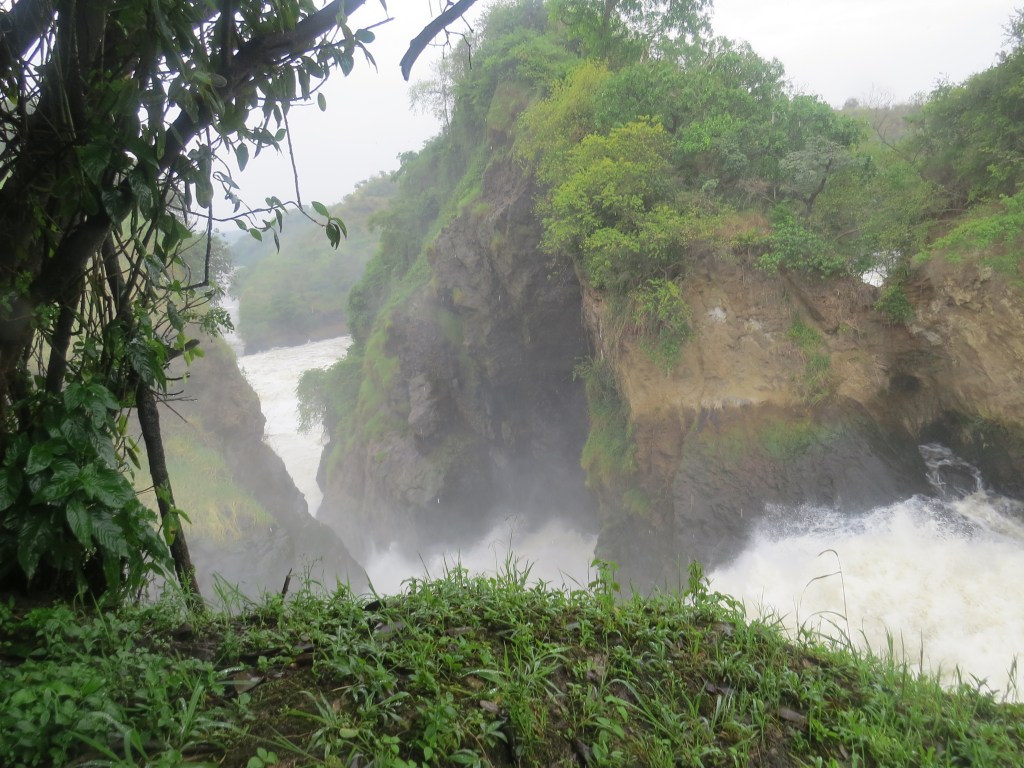
The first leg of the journey is to Murchison Falls National Park – a 50-minute flight – to meet the Nile on its most dramatic stage where the mighty river plunges 43 metres through a 7-metre chasm on its 6,000-kilometre journey north to drain into the Mediterranean in the land of the pharaohs.
Murchison on the Nile
It was Baker with his wife Florence who came upon the ‘world’s most powerful waterfall’ in 1864, when looking to solve the Nile’s source – which they did not. They named the falls Murchison after the president of the Royal Geographical Society. However, the wandering couple came upon the lake (which today spans Uganda-DRC border) that glistens in the horizon as we land in 3,893-square-kilometre Murchison Falls National Park at Pakuba airstrip – the lake they named Albert after the British queen’s husband. The duo also documented Karuma Falls, a spectacular series of cataracts along the Nile spanned today by Karuma bridge along the main Kampala-Gulu highway.
The park is lush green like an emerald with towering Borassus palms that our safari guide jokes are planted by elephants! The seed passes through the elephant’s gut and germinates on the ground.
The common patas monkeys watch us from the road side. Unlike other monkeys that prefer trees to terra firma, the patas is mostly seen on ground and with its long legs is a fast runner. Unfortunately the Kenyan patas monkey is extinct in the wild – the Critically Endangered southern patas monkey (E. baumstarki). Found only in northern Tanzania today, the population is between 40–100 mature individuals remaining in the wild.
The Rothschild giraffes grace the plains nibbling on the acacias, Jackson’s hartebeest stand sentinel, a lioness in the tree stops all on track and finally the day ends with a drive to the top of the thundering falls on a road recently tarmacked over the new bridge spanning the Nile, doing away with the iconic ferry crossing.
The following day we sail the Nile to the bottom of the falls. A crocodile slithers into the river; others stay statuesque with jaws wide open to cool down in the afternoon heat. A herd of elephants frolic on the river’s edge hosing themselves with the rich red mud – a spa in the wild. FYI – Baker had by the age of 20, invented a powerful gun to kill an elephant with a single shot.
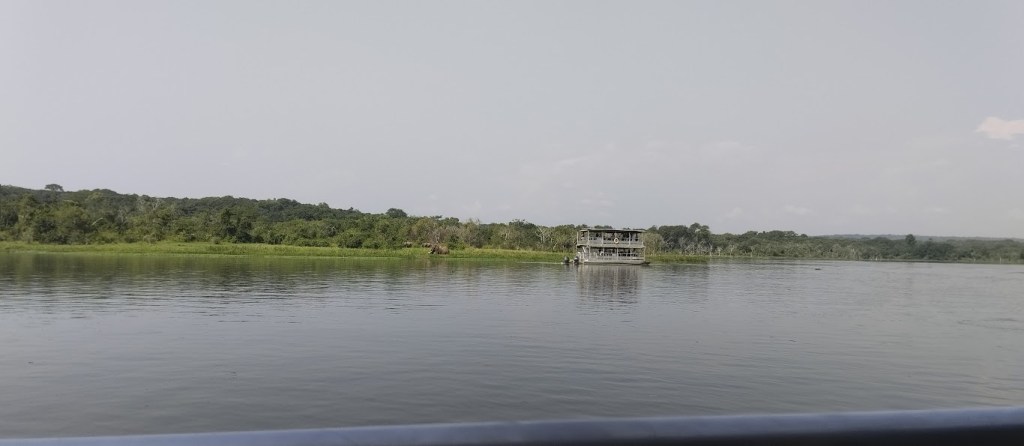
Pods of hippos pop around in the blue waters and we give them a wide berth. In 1870, Baker’s boat was attacked by an angry hippo on the Nile who munched a large mouthful of the wooden vessel. An hour later we sight the falls – and they never fail to impress. The river has risen and the force of the falls keeps the boats at a distance. All we can do is watch in awe with its permanent rainbow.
The Nile tumbling through a 7-metre gap down 43 metres to the land of the pharoahs. Pic: Rupi Mangat
More on Murchison Falls
It’s easily doable from Nairobi via road or by air with a range of accommodation in and outside the park. Combine the falls for a safari circuit with Budongo or Kibale forests for chimpanzee trekking; Queen Elizabeth National Park and Bwindi for the Mountain gorillas.
Log on to Uganda Wildlife Authority for current park fee.
On Global Big Day 10 May 2025 from Lake Elmenteita Serena Camp
Above: The Sleeping warrior aka Delamere’s nose between Lake Elmenteita and Mt Eburru. Credit Aloise Garvey
By Rupi Mangat
Published Saturday Nation newspaper magazine 17 May 2025
It’s the calm of the morning, serene and quiet, one that l don’t want broken, one that l am alone in. In this world in front of me, a solitary Great White Pelican swims in the expanse of the grey-blue lake, reflected in its still waters as is the massif of Eburru and the profile of the Sleeping Warrior that we knew as Delamere’s nose in days past.
Soysambu Conservancy with Flamingos on Lake Elmenteita and Delamere’s Nose. Copyright Rupi Mangat
It’s still early and it’s the day to celebrate birds for it’s the Global Big Day for birders all over the world with birders in Kenya fanned out in the country except in the north-eastern. I’ve teamed up with two super birders Aloise Garvey Maina and Anthony Mokaya at Soysambu Conservancy to log in as many species of the feathered kind on the eBird app in a bid to make Kenya ranked amongst the top ten countries for birding. The giants of the birding world that have never been toppled since the start of GBD in 2014 are Colombia, Peru and Ecuador with Kenya hovering in the 7th or 8th position. Our mission is to inch closer to the coveted top spot.
As the morning warms the yellow-barked acacia woodland and the lawns of Lake Elmenteita Serena come alive with the cacophony of birds where Aloise is a most sought-after naturalist. By 8 in the morning, Aloise and Anthony have logged in 50 species at the camp and after a filling breakfast of freshly-baked pastries and fresh fruits followed by a hearty helping of a cooked breakfast, we’re driving out into the conservancy that takes its name from the Maasai words for ‘the place of striated rock’ and ‘Sambu’ for the cattle colour, aptly chosen by the first Lord Delamere.
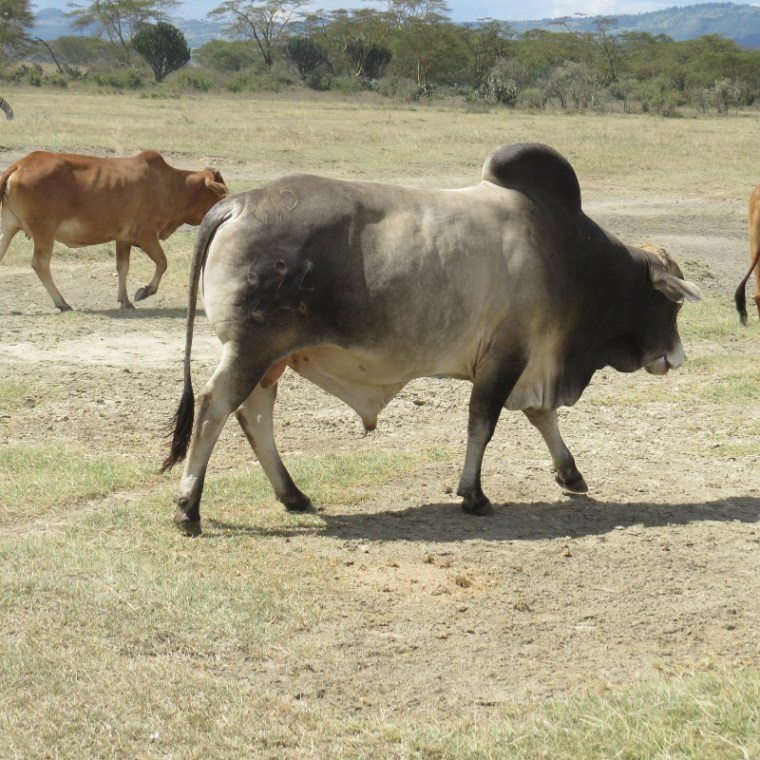
Boran cattle at Soysambu. Copyright Rupi Mangat
A colourful character from the past, he walked some 1,000 kilometres from Berbera in Somaliland to arrive in Kenya in 1897 when only in his early twenties. He then swopped his palatial estate in Cheshire to fund his projects in his adopted home building himself a mud-hut that was doorless and windowless to sleep. Delamere introduced the short-horn cattle and cross-bred them with the indigenous Borana cattle that became a hallmark of the beef industry. It’s history framed on the canvas wall of the palatial lounge fashioned after the early days of safaris that the rich came to Africa for in the early 1900s.
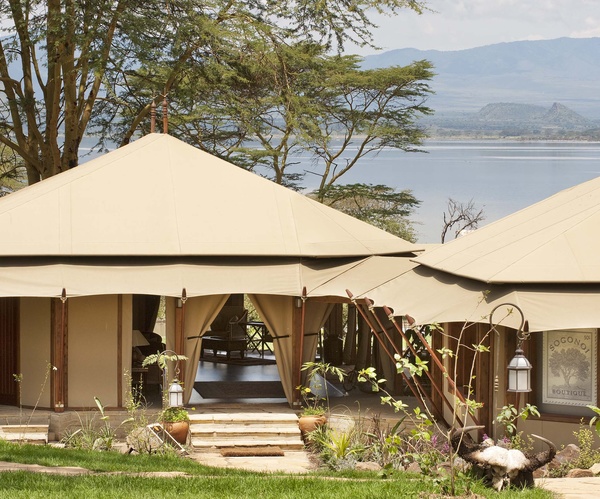
Lake Elmenteita Serena Camp
Having morphed from only a cattle ranch into a wildlife conservancy that’s famed for its 450 species of birds, lions, 10 percent of the global population of the endangered Rothschild giraffes, and so much more, we’re regaled by a Green-headed sunbird which the two men are keen to photograph. “The Green-headed sunbird is a central Kenya species but when it’s too cold in the highlands, it flies south for warmer climes,” narrates Aloise who grew up fascinated by nature mentored by his grandfather.
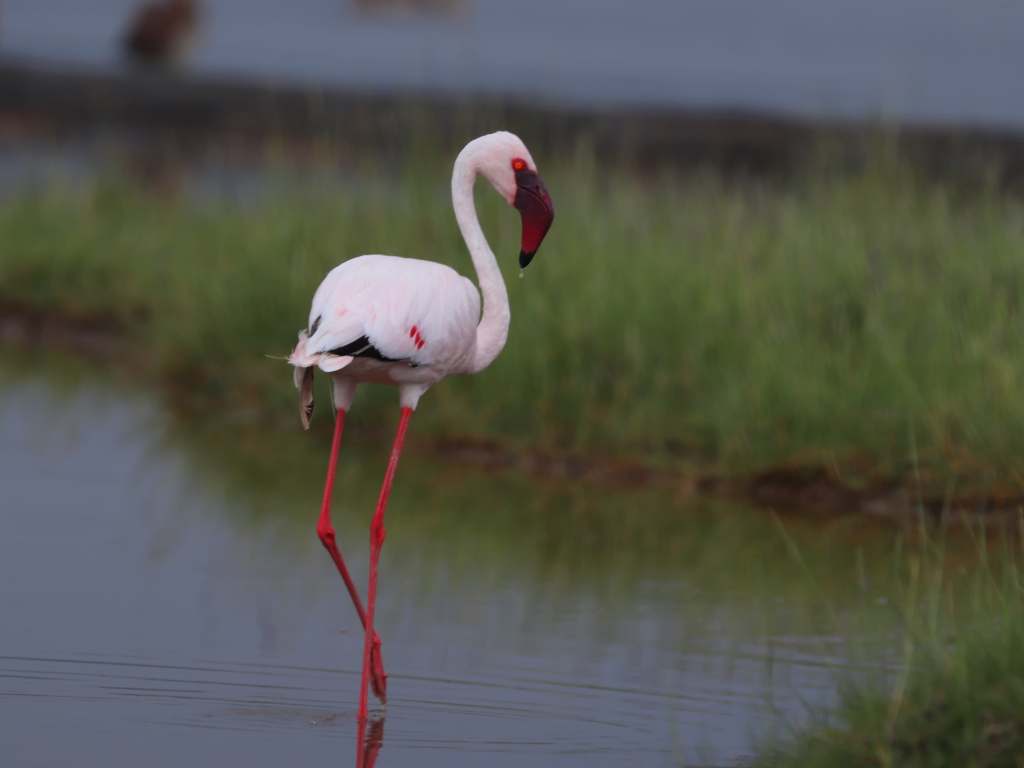
A solitary Lesser flamingo in the now-fresh Lake Elmenteita. Credit Aloise Garvey
Armed with binoculars and super-powerful cameras like the Cannon R5 with a 200-800 mm lens, we scan the plains peppered with lilac and white wild flowers and scour the blue skies. The men shoot the Martial that’s the most powerful and a pair of Tawny that has them wandering into the grassland when they are surprised by a pair of Secretarybirds stalking for their menu of snakes and rodents. Numerous until recently, these stately birds are now labelled ‘endangered’. Mokaya is elated when he logs in the Coqui francolin, a lifer for him – meaning it’s the first time he’s seeing it.
The list expands, a herd of Rothschild amble by, a pair of Silver-backed jackals frolic in the long grass and by the lakeshore that’s risen from a single-digit foot to 30-plus, the handsome bulls for beef with impressive humps are herded for a drink to the lake in the company of the Grey white pelican that perform a synchronized dance to gulp their fish. The now-submerged islands in the lake are their only breeding ground in East Africa.
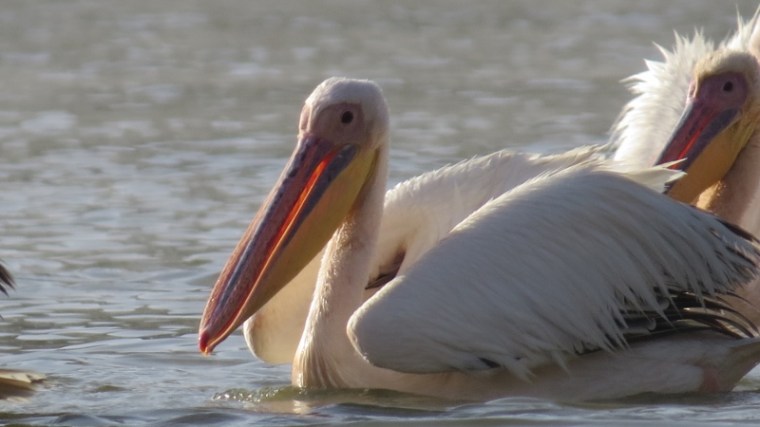
Great White Pelicans getting ready for breakfast. So they have to pool together and start herding the fish in a tigtt fist. Then the pelicans will upturn themselves with just their ‘tutus’ showing while they open their great big bills and snap up the fish. Copyright Rupi Mangat
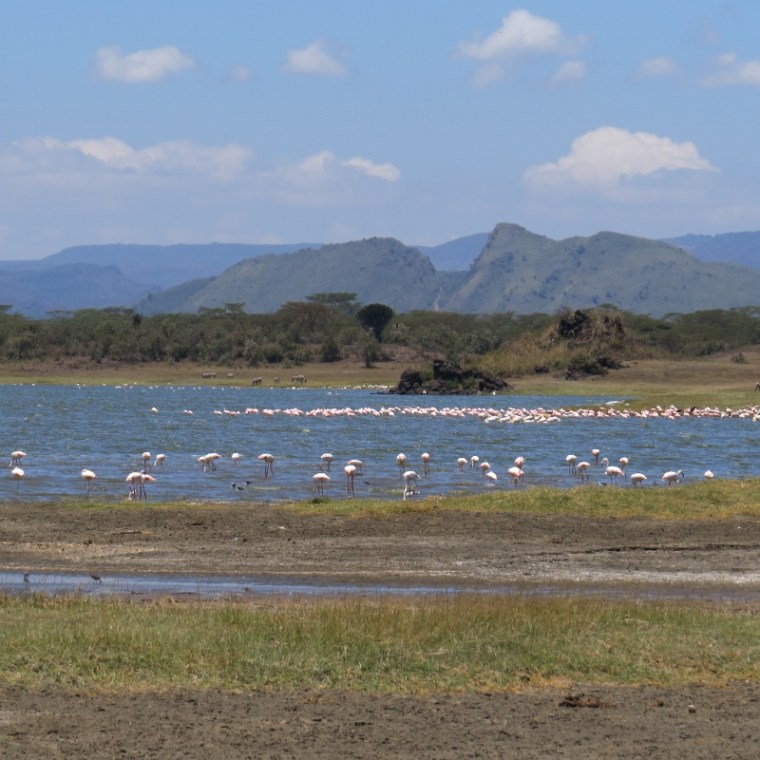
The Merorani flows in spate, few flamingos grace the lake and by eventide with 166 species logged in, we return to the comfort of the camp to dine on exquisite foods. Click the linkhttps://ebird.org/checklist/S235684791 to see Aloise’s bird list on GBD. The preliminary results has Kenya ranked 8th.
Log Lake Elmenteita Serena Camp to see the 24 palatial en-suite tents that come complete with king-sized beds and chandeliers. Lake Elmenteita Serena is for the discerning traveller without the crowds. Indulge at the signature spa, swim in the heated pool, or ride the horses and camels by the lakeshore, game drives and nature walks– the camp’s fashioned to revel in nature.
Legend has it that God was so impressed with the gentleness of the mighty wanderer of the oceans, that he threw fistful of coins on its back – hence the Kiswahili name for it –Papa shilling which loosely translates to “Shark covered in silver coins.”
I arrive in time to catch the whale shark boat in search of the world’s biggest fish – the whale shark. It’s super-hot being March with the morning tide coming in. Volker Bassen, operator of the Whale Shark Adventures and co-founder of the East African Whale Shark Trust is at the helm with his crew of professional underwater video/photographers and dive masters.
There’s excitement on board for the whale shark is no ordinary shark. Despite being humongous – it can reach lengths of 60 feet and weigh as much as 36.000 kilograms – it’s so gentle that you can swim alongside it. Being a shark, it does have jaws but the teeth are tiny and harmless. Instead this giant of the seas is a filter feeder using its mouth to draw in water and filter out plankton and small fish.
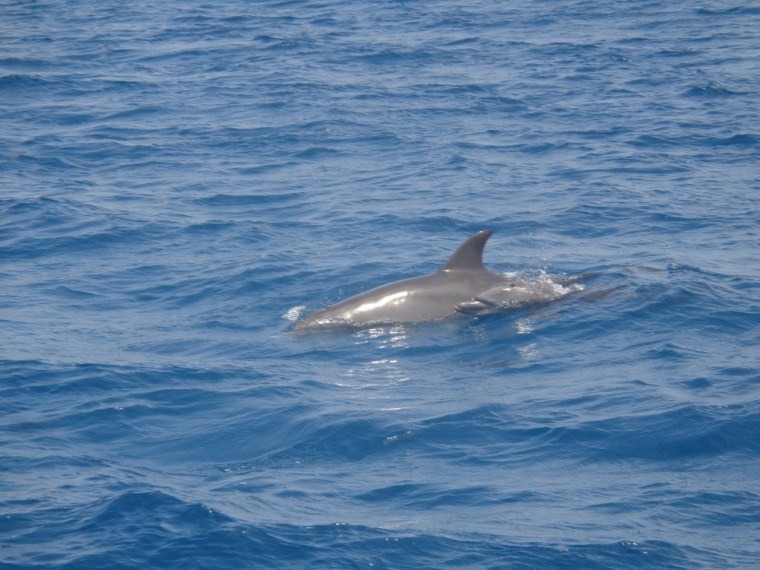
Further into the ocean, the wind picks up, the waves gain momentum. The sky melds with the sea in shades of blue. The underwater world holds magic that awes the mere human on the boat. A pod of bottlenose dolphins in supreme grace slip in and out of the ocean, silvery grey against the dark blue. After a few minutes of curious playfulness around the boat, the dolphins vanish into their world.
Bottlenose dolphin with young in Kisite-Mpunguti National Marine Park
Copyright Rupi Mangat
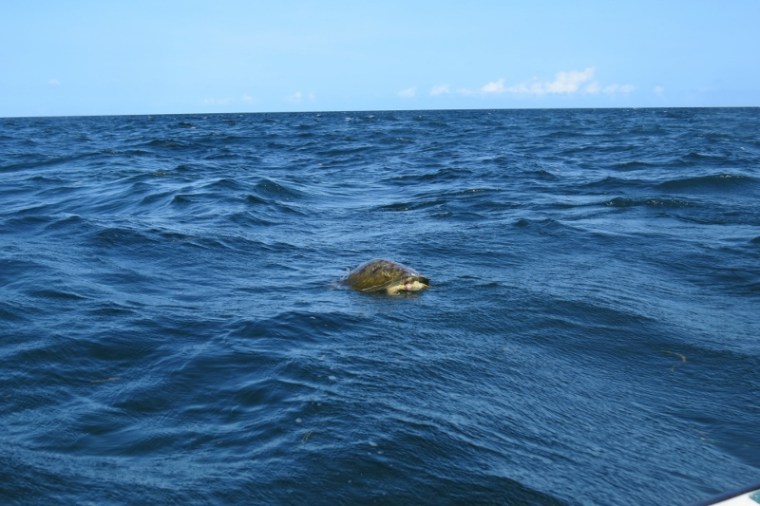
There’s still no sighting of the whale shark. On my first whale shark adventure with Bassen in 2008, the big fish had appeared within moments of us reaching the reef. We reach a patch of the ocean that’s calm and jade green. Heads begin to bob in and out of the water. We’re in the company of the green turtles – the ancient mariners of the sea that have outlived the dinosaur. Being reptiles, they need air to breathe and pop their heads out of water for a few seconds. Joana Hancock of the Olive Ridley Project (the Olive Ridley is the most abundant of the turtles species found in all the world’s oceans i.e. Indian, Pacific and the Atlantic) later tells me that these are resident green turtles – for now until they migrate further into the endless ocean. In one of nature’s most amazing feats, the female returns to the beach she was born on to lay her eggs.
Green turtle – Kiunga Marine National Reserve
Copyright Maya Mangat
It’s nearing noon and still no big fish. Despite its gigantic size, you would think it’s easy to spot the whale shark. But this once abundant shark faces increasing collisions by the ocean liners, maimed by the propellers or caught in the massive seine purse nets in the fishing industry.
All the goggle-eyed snorkelers know that there is the odd day that the whale shark will elude all, for it is one of the most elusive creature on the planet. They jump into the water to swim with the turtles and be fascinated by the rich colours of the coral reef. Humans being warm-blooded mammals return on board having had their share of fun while the cold-blooded reptiles remain in the sea. On board there’s fresh fruits awaiting – and a surprise.
‘Mzee Pombe’ is a fixture by the reef which at low tide reveals a sandbar. Having paddled on his surf board with a cooler-box full of cold beers and soft drinks, his floating bar is an instant attraction and soon everybody has a drink in the hand.
It’s the last sail day of the season for the whale shark as it continues its swim in its constant search of food like the fish and coral spawn and the plankton blooms. There’s still so much we do not know about the ethereal Papa shilling that researchers like the EAWST team is dedicated to finding out to ensure the survival of the world’s biggest fish.
Swim with the Whale Shark
Join EAWST on a sail day in search of the whale sharks, turtles. dolphins and humpback whales.
The whale sharks arrive in Diani-Kenya around mid-December until mid of March as they continue with their migration on routes unknown and reappear a year later.
“You can never tell where they are going,” says Bassen. “It’s a very mysterious fish.
EAWST tagged 22 whale sharks between 2007 and 2010. One swam to Mozambique, one to Djibouti and one towards Australia.Due to lack of funding, the project stopped. However EAWST operates microlight spotter aircraftswhen the whale sharks and humpback whales are around to monitor their movements.
Note: the humpback whale season starts mid-July until end of September.

 Moonlion Safaris