The horrific illegal trade in cheetah cubs and other endangered wildlife fuelling the exotic pet trade
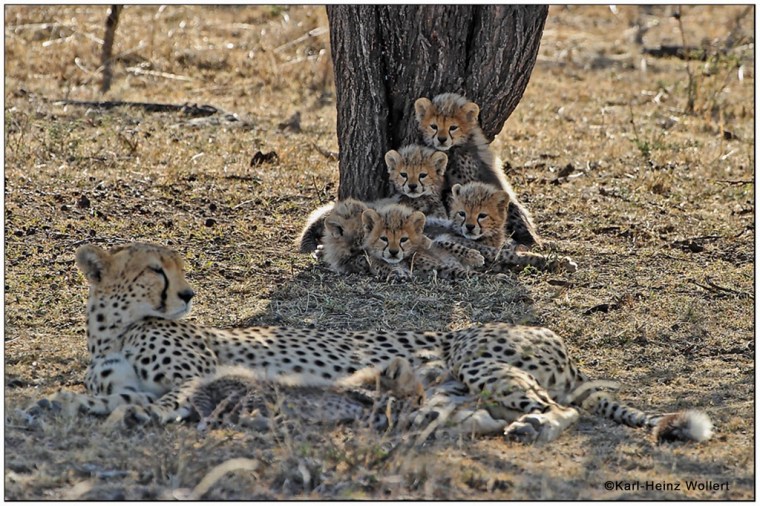
Wild Cheetah cubs with their mother in the Maasai Mara National Reserve, Kenya Picture copyright Karl-Andreas Wollert.
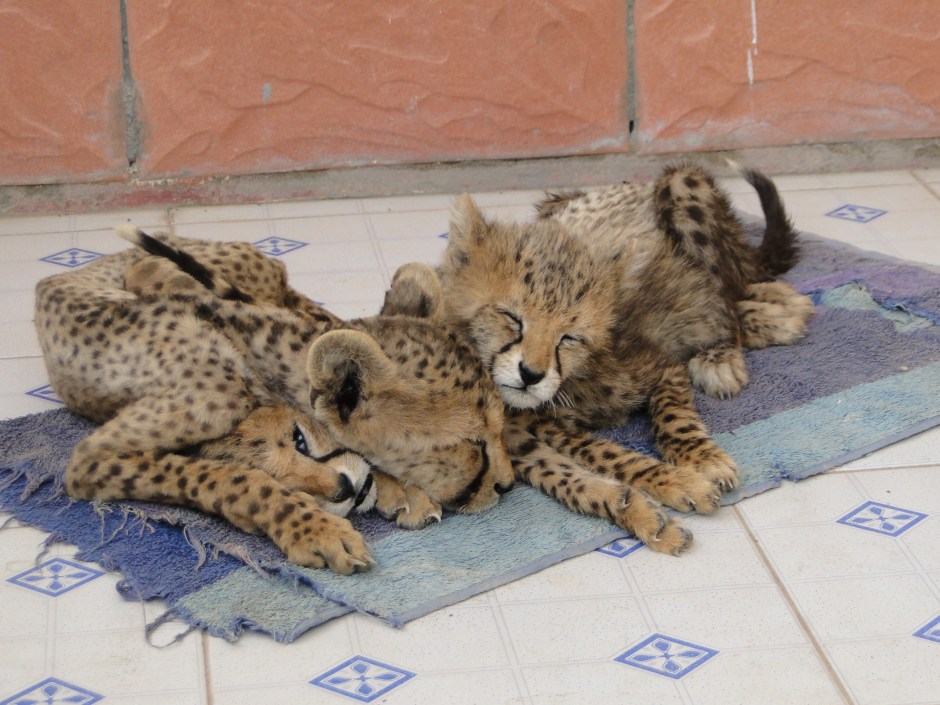
It was a phone call from a U.S. Marine in November 2005 that put the wheels in motion for Patricia Tricorache, assistant director for strategic communications of the Namibia-based Cheetah Conservation Fund (CCF) to add ‘illegal wildlife trade’ to her title.
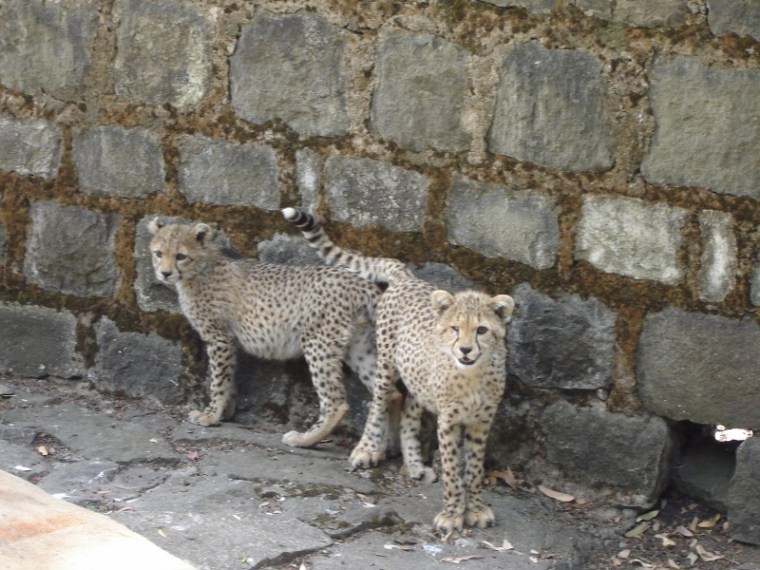
“He was calling from Ethiopia about two cheetah cubs that were tied with ropes outside a restaurant in Gode, a remote village in eastern Ethiopia. He was a vet and said that the cubs would die soon; he was considering buying them.
“I begged him not to buy them because it would only encourage more poaching. We frantically began calling everyone we knew in Ethiopia, including the Environmental Protection Agency (EPA), the Ethiopian Wolf Conservation Program and the U.S. Embassy.
Aruba’s past and present in Tsavo East National Park
Published Saturday magazine Nation newspaper 24 December 2016
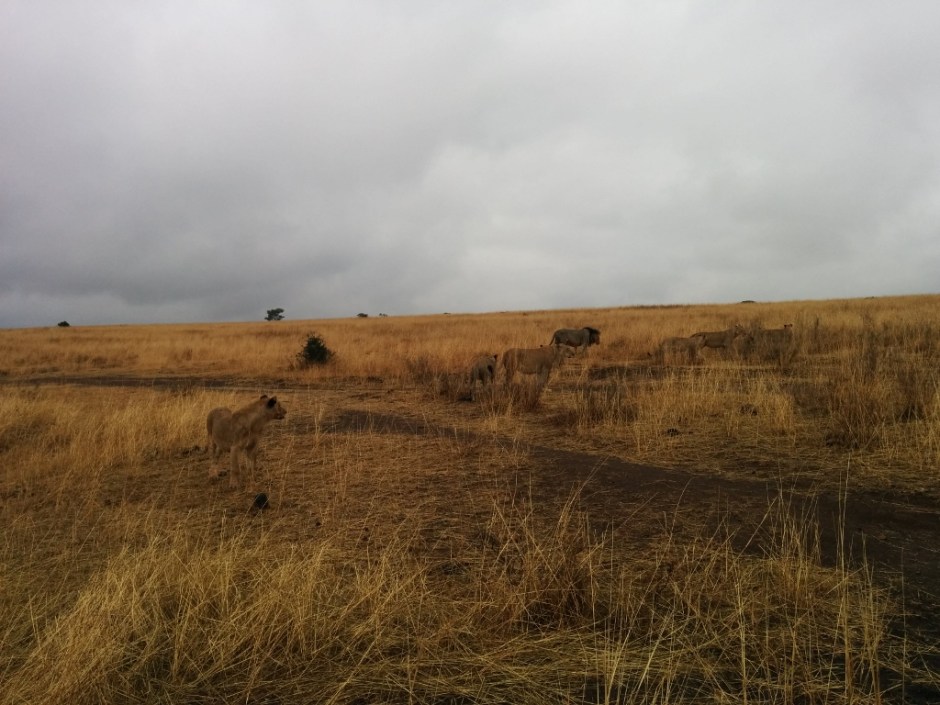
Lioness in Tsavo East National Park Copyright Rupi Mangat
Ashnil Aruba Lodge – lounge Copyright Rupi Mangat
Mudanda Rock – 1.5km long – gives views of the park, the bridge and the road Copyright Rupi Mangat
Aruba holds a special fascination because of the sighting of the critically endangered antelope, the hirola that number 300 to 500 in the wild with none in captivity. The International Union for Conservation of Nature Red List reads that “The loss of the Hirola would be the first extinction of a mammalian genus on mainland Africa in modern human history.”
Also known as the Hunter’s hartebeest and found in the arid lands of northern Kenya and Somalia, it was first described by the zoologist H.C.V. Hunter in 1888. By the 1970s the numbers were about 15,000 but rapidly crashed to over 90 per cent following a wave of hunting. In 1963 and 1996, some were brought into Tsavo East. Today the number is about 77.
Grounds of Satao Camp in Tsavo East National Park Copyright Rupi Mangat
Animals seen at the waterhole at Satao Camp in Tsavo East National Park Copyright Rupi Mangat
Beautiful grounds of Satao Camp in Tsavo East National Park Copyright Rupi Mangat
Yummy breakfast jams at Satao Camp in Tsavo East National Park Copyright Rupi Mangat
The waterhole at Satao Camp with a webcam to ‘catch’ animals coming to the waterhole Copyright Rupi Mangat
Beautiful luxury tented accomodation at Satao Camp Copyright Rupi Mangat
It’s the night of the 21st of November when a dazzling red-orange meteor with a blazing tail zips across the sky making it an incredible OMG moment for no one in the group sitting around the camp fire at Satao Camp in Tsavo East has ever seen such a celestial event.
We take it as a sign of good tidings of what’s to follow in the great Tsavo that only sixty years ago was the kingdom of the greats. Thousands of elephants and black rhinos roamed the thorn-filled plains of Tsavo East where no road had been carved save for the Lunatic Line constructed in 1900.
And now – the luxury of the unpretentious camp set deep in the heart of Tsavo is enchanting. “The spot where Satao Camp is built is called Mwakwaju,” explains Mike Kirkland of Satao. “Satao means giraffe in Waliangulu.”
Ah huh!
The Waliangulu were the master elephant hunters who used poison tipped arrows to hunt.
“The Waliangulu still exist,” continues Kirkland. “When Tsavo East was gazetted in 1948 they were re-located from Tsavo East to the Sagalla Hills where they were given land.”
The iconic hill at Voi is part of the Eastern Arc chain of mountains that harbour some of the rarest endemics in Kenya like the worm-like Sagalla caecilian – an unusual amphibian (same family as frogs) and threatened with habitat loss.
It’s the bird song that awakens us in the morn and a beautiful blue sky on unzipping the tent. The waterhole so stark blue is blinding by the centuries-old tamarind tree. It’s intriguing for tamarind trees are from the Orient and associated with the slave trading caravans of centuries past. Was this a staging post?
Everything is enchanting in the simplicity of the camp. A pair of tiny Pearl-spotted owlets settles on is favourite tree for the day – the thorny commiphora. They are the world’s tiniest owls – the size of a hand. As we enjoy breakfast, golden sunbirds hold the eye.
Gorgeous flower of the Delonyx elata in Tsavo East Copyright Rupi Mangat
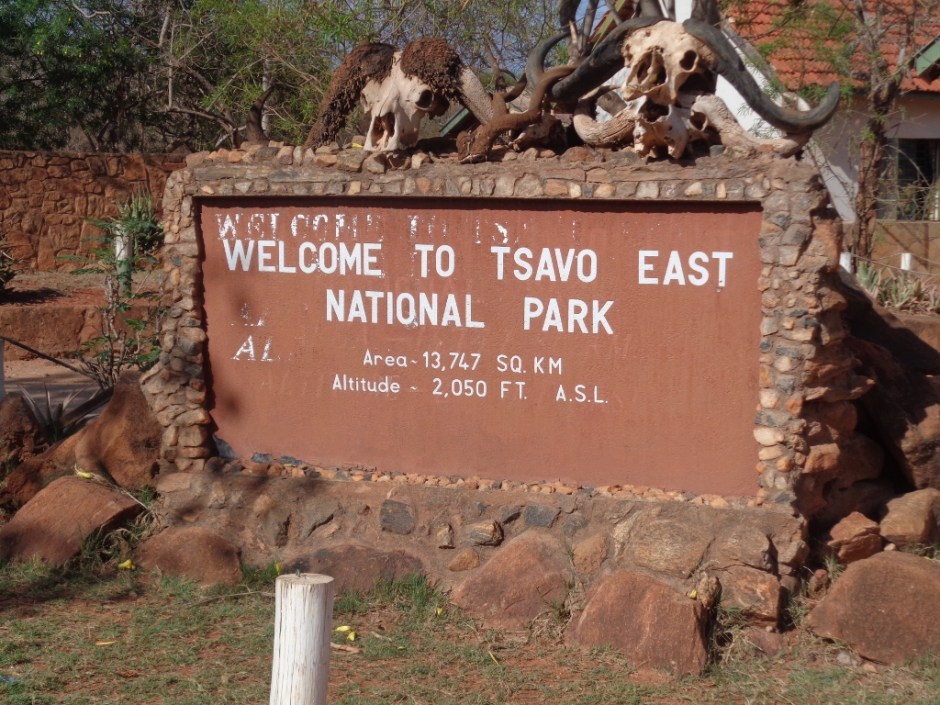
Tsavo East National Park entrance at Voi Picture copyright Rupi Mangat
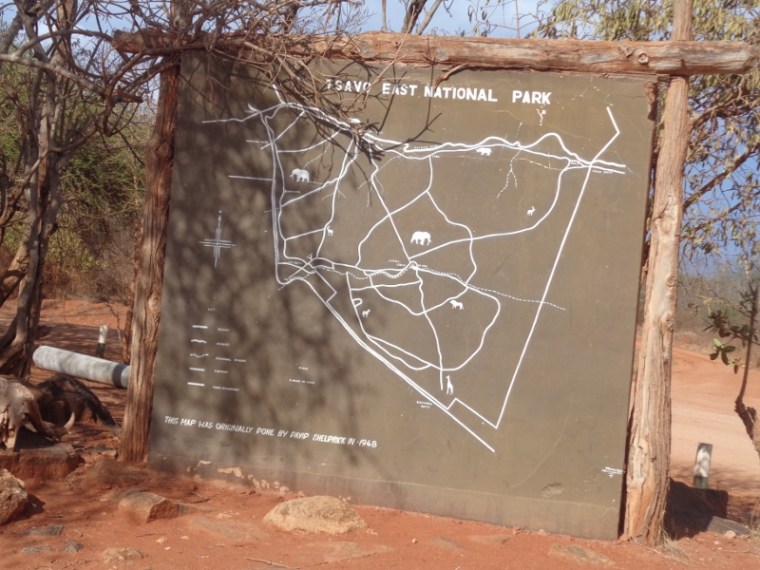
Map of Tsavo East drawn by David Sheldrick – first warden of the park in 1948 Copyright Rupi Mangat
And then we’re out for the day in the mighty Tsavo derived from the Waliangulu word for slaughter. It’s taken just one storm after months of drought for the plains to transform. Red termite mounds dot the palatial plains and every tree of the Delonyx elata is in a burst of gorgeous flowers. The space is heady.
“Tsavo East completely transforms when the rains come,” Kirkland explains. “It usually misses out on the long rains until the November/December short rains.”
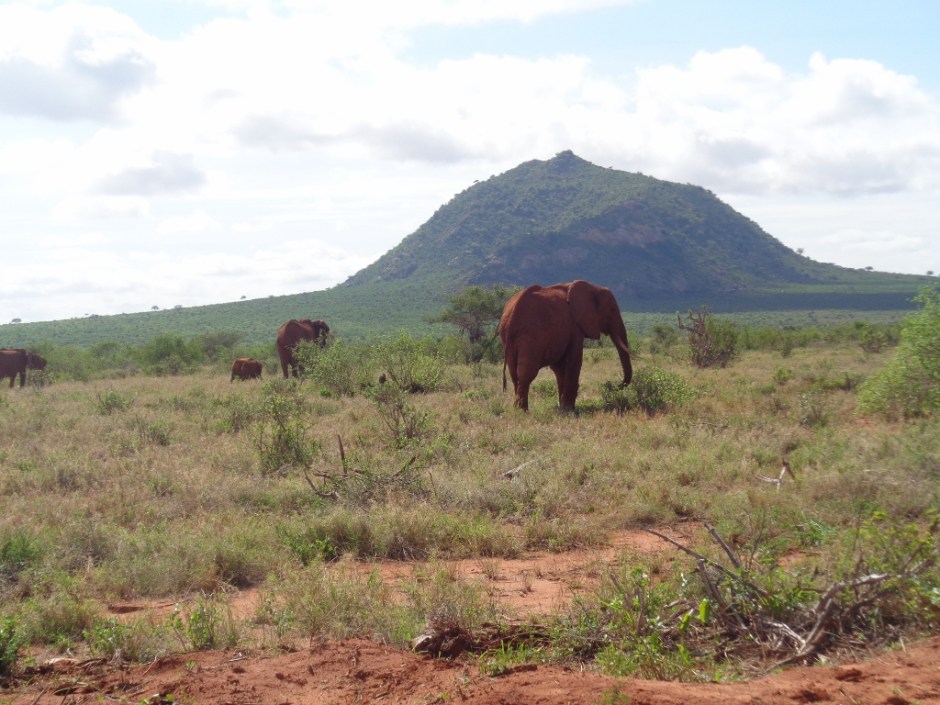
We’re the sole vehicle for hours on the plains. And then suddenly there’s a herd of three hundred of Tsavo’s iconic red elephants – big tuskers, teens, mums and babes. It’s beyond belief to see a herd like this today but still nowhere near the tens of thousands that literally filled the horizon even until the 1960s.
In 1976, 20,000 elephants remained in Tsavo East according to the writings of Dame Sheldrick. But the next three decades reduced the elephant population to just 6,000 within the entire ecosystem, an area twice the size of the Park itself, where once there had been 45,000.
With poaching under control and great security, the bright side is that elephant numbers are on the increase with 12,000 around Tsavo East according to the 2014 count.
“We now have 13 black rhinos in a new black rhino 100-kilometer-square sanctuary, all fenced and we’re moving 10 more rhinos from Ngulia sanctuary and Nairobi National Park,” tells John Wambua, the park’s senior warden.
The day passes with a picnic lunch on the Dika plains with hills of Kasigau, Maungu, Sagalla, Dawida and Mbololo stretched in the skyline.
Lugard Falls on Galana River flowing into the Indian Ocean near Malindi Copyright Rupi Mangat
Lugard Falls in Tsavo East Copyright Rupi Mangat
The new steel bridge near Lugard Falls shouldering the Yatta Plateau – longest lava flow in the world – connecting the northern and sounther parts of Tsavo East Copyright Rupi Mangat
The following morning at Lugard Falls on the Galana River water gushes over the chasm of rocks now submerged. During the dry season, rocks gleam where the rich earth-coloured water flows. Named after the colonial administrator, Lord Lugard who first described the area and had his finger bitten by a crocodile, a new steel bridge shimmers over the river.
On a whim, we drive to it stopping at Crocodile Point where the slithering reptiles rest on the beaches and rocks and over the bridge and up the Yatta Plateau – the world’s longest lava flow.
“The new bridge links the southern and northern side which for long was not open. Now because of security we have animals like elephants in the northern area,” tells Wambua.
That means there’s more to explore of the mighty Tsavo.
Map of Tsavo East drawn by David Sheldrick – first warden of the park in 1948 Copyright Rupi Mangat
A leisurely hour’s drive from KWS Voi Gate, Satao Camp is ideal for nature-lovers yet rustic luxury for all.
If you’re driving in from Malindi, use KWS Sala Gate. Or KWS Manyani Gate to access Nairobi-Mombasa road. The enormous SGR and the 70-meter underpass for wildlife are by the gate.
The park is big – 13,747 square kilometres – so two to three nights is ideal.
Celebrating her 70th ‘Birthday’ on the Saturday 17th December, 2016
Zebra on the plains of Nairobi National Park Copyright Rupi Mangat
Beautiful sky and savanna of Nairobi National Park Copyright Rupi Mangat
Nairobi National Park will be celebrating her 70th ‘Birthday’ on the Saturday 17th December, 2016.
We will mark this day with a peaceful Save Nairobi National Park/Commemoration Walk From Nyayo Stadium to Bomas of Kenya along Lang’ata Road from 10 a.m. to 1 p.m.
This is a great opportunity for those who have not been able to participate in the peaceful protests we have had during the midweek.
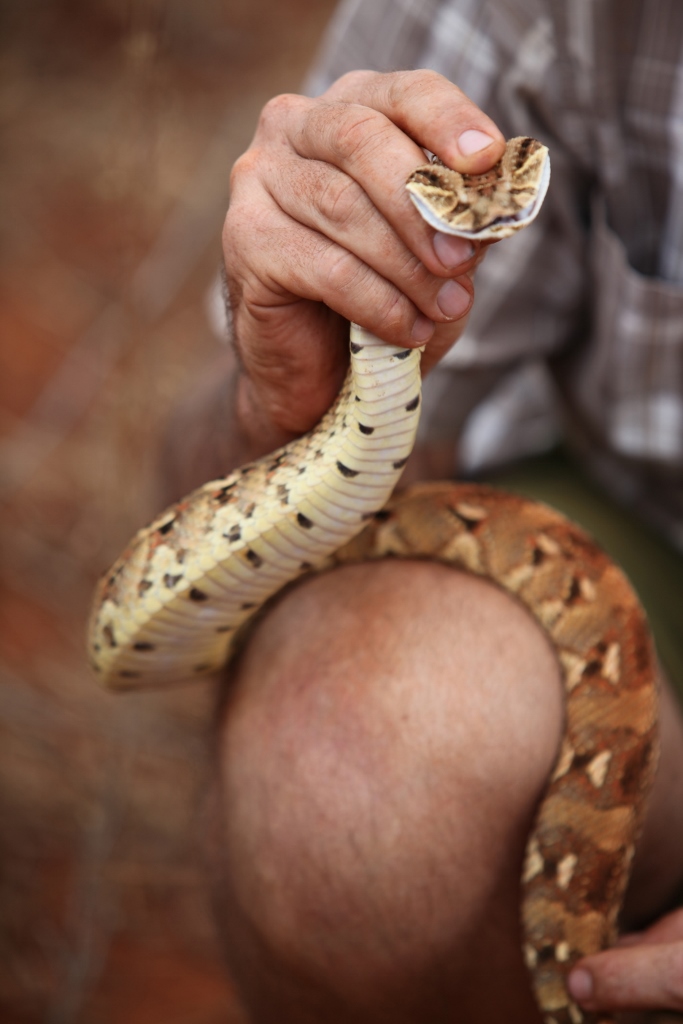
13-year-old Menza Benjamin was picking up cashewnuts on the ground when he felt a burning hot bite on his leg followed by another. He started to vomit and broke out in a cold sweat. Close to his hut he fainted. He never saw the snake.
That was three years ago and he’s lucky to be alive, sitting at the snakebite seminar held in Watamu early November.
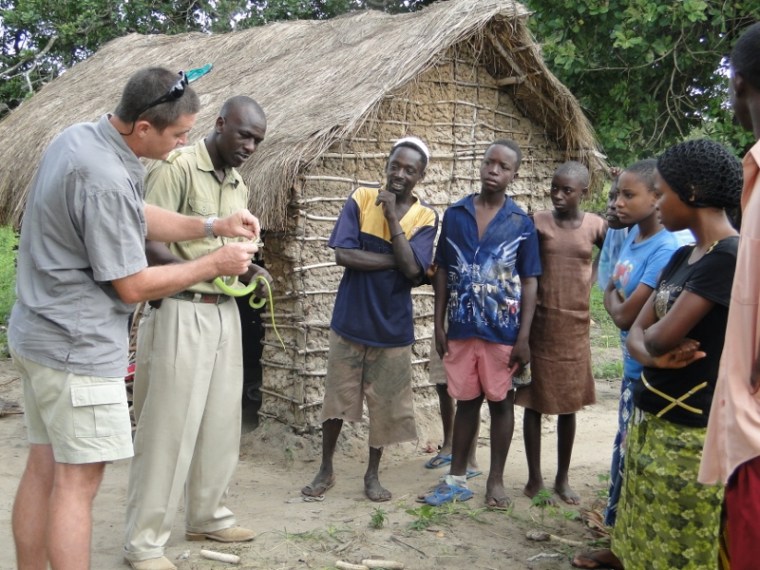
Royjan and Boniface who had been called by these villagers to catch a snake in the roof of one of their huts. It was a green mamba. Royjan and Boniface took some time to talk to them and answer their questions. Picture copyright Royjan Taylor
What saved Menza was the speed with everything that followed. His uncle saw him and immediately put him on a pikipiki and took him 12 kilometers to the Bio-Ken Snake Farm. By the time they reached the snake farm, the boy was already showing rapidly advancing symptoms of black mamba bite. He was rushed by car – along with a supply of suitable antivenom to the local private hospital where he was treated by the hospital’s founder, Dr. Erulu, also present at the seminar.
Black mambas are among the fastest and deadliest snakes in the world. A bite requires urgent urgent attention.
Young Menza with Royjan after surving in his Black Mamba bite. Copyright picture: Rojjan Taylor
A young Orma girl who was treated successfully with good Antivenom from a Red Spitting Cobra bite. Picture copyright Royjan Taylor
The young man who recently died in Voi from bad Antivenom.








 Moonlion Safaris