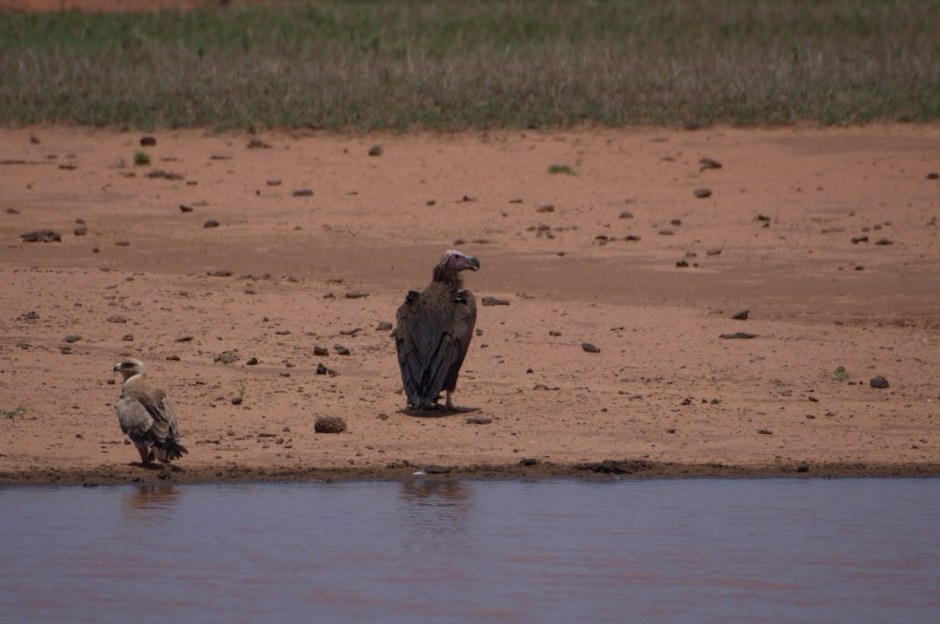
Above: Lappet-faced vulture with Tawny eagle in Tsavo West National Park at Lake Jipe on the Kenya-Tanzania border
Copyright Rupi Mangat
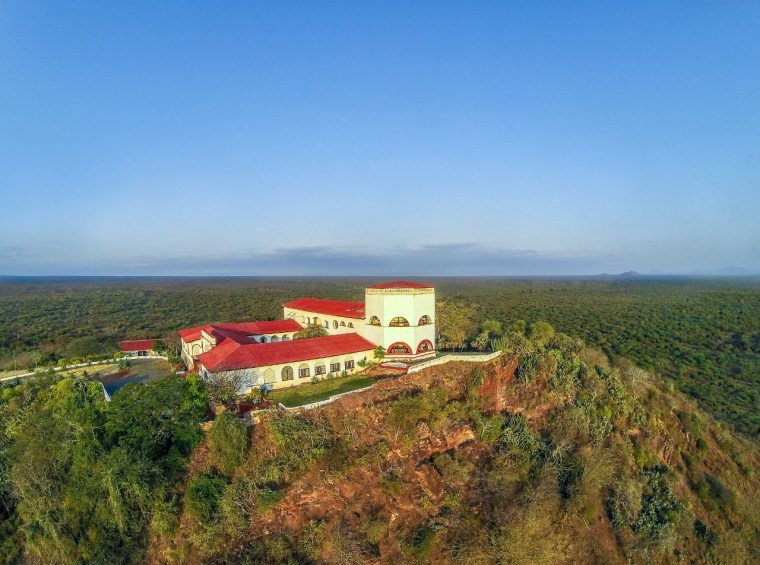
Aeriel view of Grogan’s Castle with Kilimanjaro Copyright Grogan’s Castle
The road from Grogan’s Castle is a long thin thread through a bush-filled veld of Prosopis juliflora, one of the most terrible invasive plants in the world. These water-suckers compete for water with indigenous species and are so aggressive that one was found with roots at 175 feet deep in the earth.
This April 8, 2017 Pre-translocation ecological assessment of Mount Kenya Guereza and the habitats of Soysambu Conservancy. resulted in an accelerated human-guereza conflict as the groups crop raid to supplement the meager wild food.
To save this population, 142 individuals were successfully translocated to Karura forest in 2016 and over 200 individuals still remain in the fragmented private riverine habitats of Kipipiri. Urgent translocation efforts are therefore, required to safe these groups from being exterminated in the near future. Such an effort however, requires identification of a suitable habitat with enough food, cover, security and away from human habitation and especially the agricultural community to minimize human-colobus conflicts in the sink habitat.
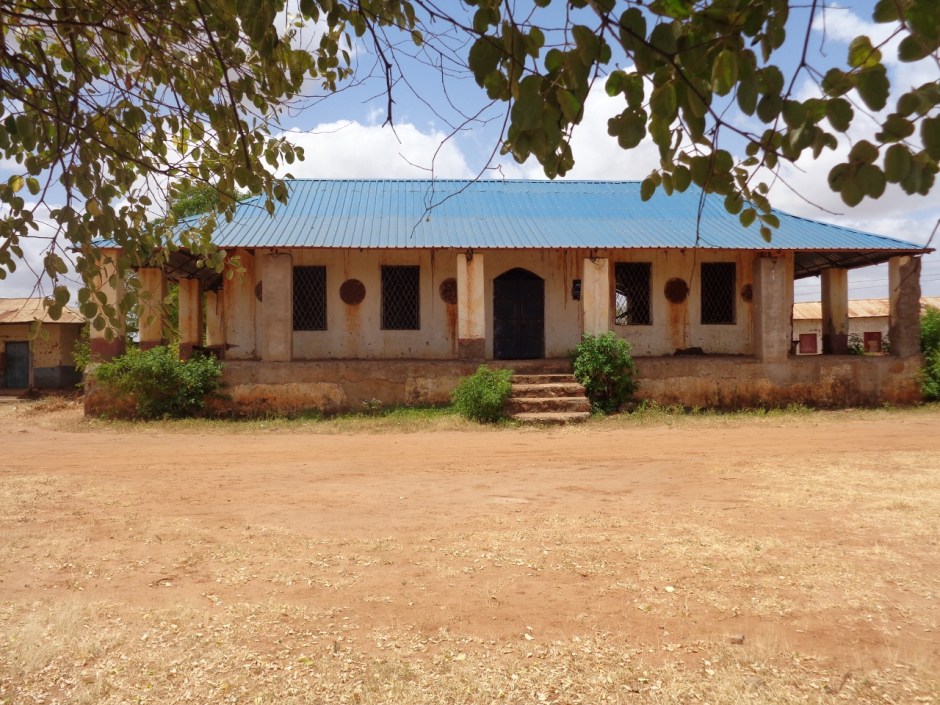
Main pictures: Africa Inland Church established 1895-1914 in Ikutha overlooking Yatta plains -copyright Rupi Mangat
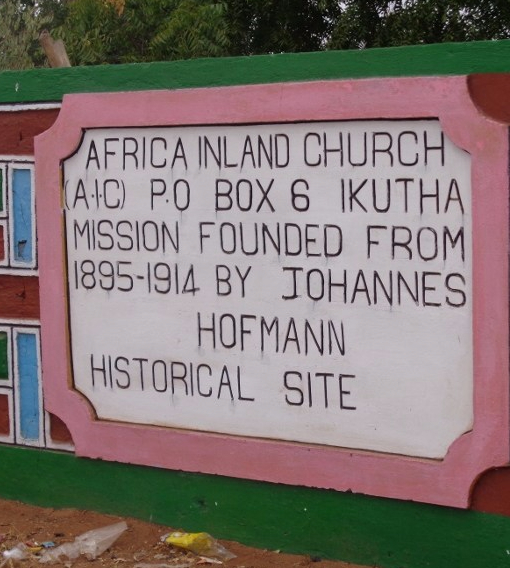
Africa Inland Church in Ikutha founded 1895-1914 by Johannes Hofmann – a historical site Copyright Rupi Mangat
Kitui’s first step to fame is that it was somewhere in the now-mapped county that Johann Krapf became the first European to sight Mount Kenya’s snowy peaks from the village of the strongman – Chief Kivoi in 1849 – and the outside world came to know of the mountain on the Equator. It’s also from the Kikamba lingo that the country’s name is derived from – when Krapf asked the locals what the mountain was called, they replied Kinyaa – the mountain of the ostriches because of its snowy white peaks against the black granite.
Above: The gorge with Ewaso Nyiro river flowing from the wetland at Nyahururu via Thomson’s Falls to Lorian swamp in the arid lands – copyright Rupi Mangat
Thomson’s Falls in Nyahururu reveals more in its ravine flowing in the depths of South Marmanet Forest
Elephants deep in the gorge – need a zoom lens to capture them – copyright Rupi Mangat
“The elephants have been spotted,” announces Walter Muriithi of Panari Resort Nyahururu sandwiched between the rocky gorge of Thomson’s Falls and South Marmanet Forest. We rush out to drive the few kilometres around the forest bordered by local farms and stop at the electric fence. It’s a deterrent to keep the elephants from raiding the farms.
Fence at Marmanet forest and the farms to keep elephants from straying out – copyright Rupi Mangat
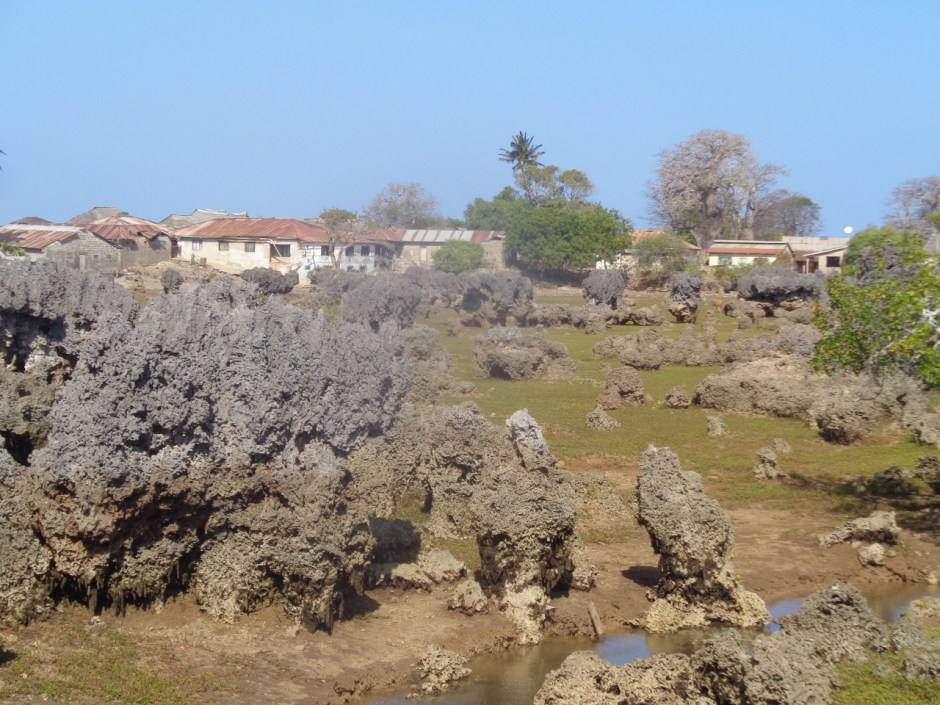
Century-old oral rag house of the Arabs – copyright Rupi Mangat
Graves of the ancestors by the century-old oral rag house of the Arabs – copyright Rupi Mangat
Wasini Island from across Shimoni on mainland South Coast near Kenya-Tanzania border – copyright Rupi Mangat
A dug-out canoe sails to the dhow anchored in Wasini Channel to paddle me to the shores of the island. In a few minutes we’re on the ancient island of fossilized coral. Wasini once a little village of makuti-thatched coral rag single-storey houses now has a few multi-floored brick buildings coming up. The century-old, ‘Arab’ houses are beginning to crumble and replaced with modern brick.
Kaole Restaurant – copyright Rupi Mangat
Cassava in coconut milk – copyright Rupi Mangat
-Husni the waiter with a plater of crabs – copyright Rupi Mangat
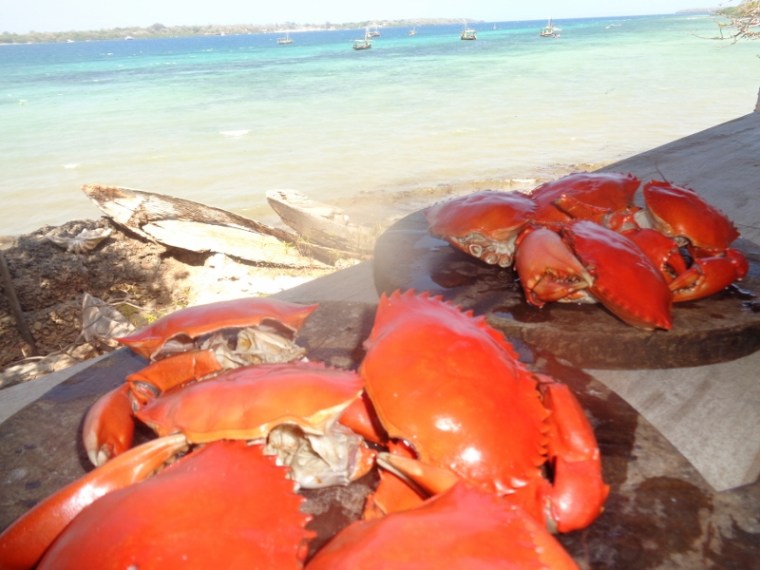
Our first port of call is to the island restaurant Kaole. Plate after plate of mouth-watering Swahili dishes waft out of the deceptively simple kitchen of the restaurant on coral rag floor and four walls with open frontage to the channel. We’re fed on crab delivered on wooden platters which Husni the waiter knocks the shell open to show diners how to tease the meat out. The table fills with spiced seaweed with chapatti, ‘wali’ and cassava cooked in coconut milk and more. We eat to our fill with the ocean breeze cooling the afternoon temperatures.
Yummy Crabs at Kaole restaurant – copyright Rupi Mangat
Modern Wasini houses – copyright Rupi Mangat
Stroling through the village – copyright Rupi Mangat






 Moonlion Safaris