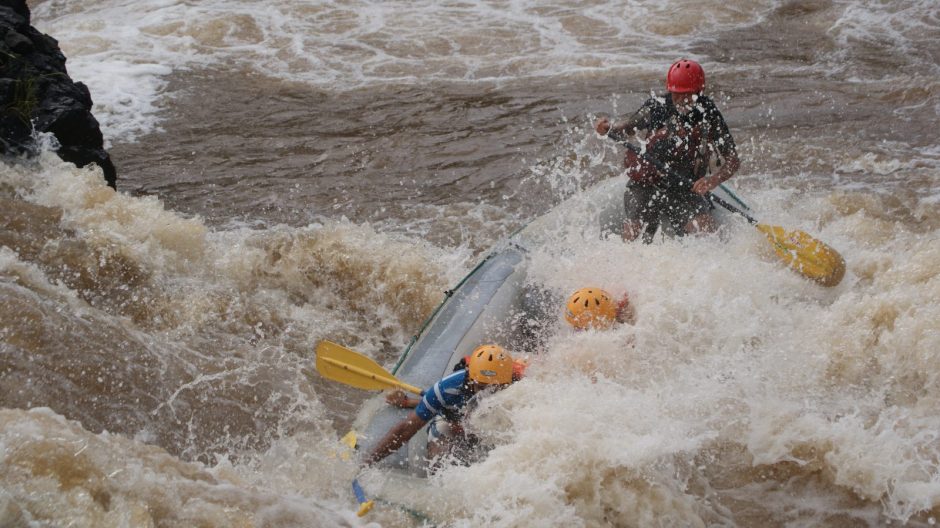
White Water Rafting

An adrenaline-filled weekend at Savage Wilderness, Kenya

“Now when the crocodile snaps the other end of your oar, don’t let go of it,” counsels Mark Savage, holding us in rapt attention. “If you let go of the oar, the crocodile will get you. Instead inch your way closer to the crocodile along the oar before it goes into the death roll.” At that point, some clue in. “What you do now is grab the crocodile’s jaws shut because it has very weak muscles to open it and jab its eyes with your two fingers like this.” At which point, some have realized that he’s pulled a fast one on us. He bursts out laughing seeing the shock on the faces of the more innocent.

“No, there are no crocodiles here,” says the man who introduced the adrenaline-filled extreme sport of white water rafting in Kenya in 1990. The group has already been briefed by an instructor on how to sit in the inflatable raft, how to hold the oar and paddle, what to do when you accidently fall off the raft and fitted us with sturdy helmets and life jackets.

Savage in his seventies is only doing the extra drill by the banks of the Tana at Sagana before we embark on the nine-kilometer run downstream through fast-flowing rapids which turns the water white because the flow is so turbulent due to the air trapped in the water.

This slideshow requires JavaScript.

Filled with anticipation and a little nervous the group carries the raft into the water. At first it’s plain sailing with Savage calling the commands to test the group on the rowing skills – left paddle, right paddle, relax. Having said that, most of the steering is done by the guide at the back- and that’s him.

Images fill me of white water rafters falling off high, fast flowing rapids. I calm myself with the golden rule – stay calm in every situation. The river’s calm but the skies break open and we’re drenched with rain.

“We’re going to die,” shouts Savage suddenly as the raft is whirled around a rapid and then sits on calm waters. That’s just an introduction on what’s to follow and he’s pleased with the group’s performance.

The Tana that we’re rafting on, demands respect not only because it is Kenya’s longest river but because it is amazing filled with lagoons and pools. Flowing through pristine landscapes like the Tsavo and draining into the Indian Ocean through a web that forms one of the most awesome deltas in the world at Kipini, it is for Kenyans what the Nile is to the Egyptians – vital to life.

The sky clears and the sun appears again. The water is smooth as silk and richly coloured like dark chocolate – a sign of silting. Along the river banks, towering palms like the raffia with the longest leaf in the plant kingdom stand with fat old fig trees.

Savage points to the ‘walking palm’ with its roots on stilts which isn’t a palm but an ancient plant from the Carboniferous Period (359 to 299 million years ago), which has formed rich coal layers in the earth.

And then we’re onto the next rapid though swirling waters and down the drop. Pumped with adrenaline, we row the rafts to the waterfall to see which capsizes first. I’m hoping it’s not ours and thankfully we miss being dunked into the water. We watch the instructor un-capsize the raft and continue with the sail. Again the water turns smooth. Eastern golden weavers and Black headed weavers weave beautiful nests on the overhanging branches of the palms and thorn trees. Green pigeons perched high watch us sail by.

A few more rapids amidst screams and laughs. We jump off the raft to swim with the current downstream and then we’re on to the final rapid. It’s nick-named the toilet bowl because the water is really turbulent and for those who want to try it, go through the drill.

Somewhere during the drill, l miss an important point which is to swim for the red point on the rock. Once inside the toilet bowl the water flushes me downstream, past enormous rocks with water gushing over me. And then the oar appears and Savage pulls me back into the raft.

I’ve been saved.

Savage Wilderness

http://www.savagewilderness.org

It’s really active. Over two days, you can white water raft, kayak, rock climb, zip line, hike a hill, swim, cycle, climb a wall and bungee jump – or just laze.

It’s an hour’s drive from Nairobi in the absence of traffic. Camp or get a cottage. The lawns are beautiful, clean with areas for BBQs. The restaurant serves good wholesome, simple meals with tea, coffee and water available free.
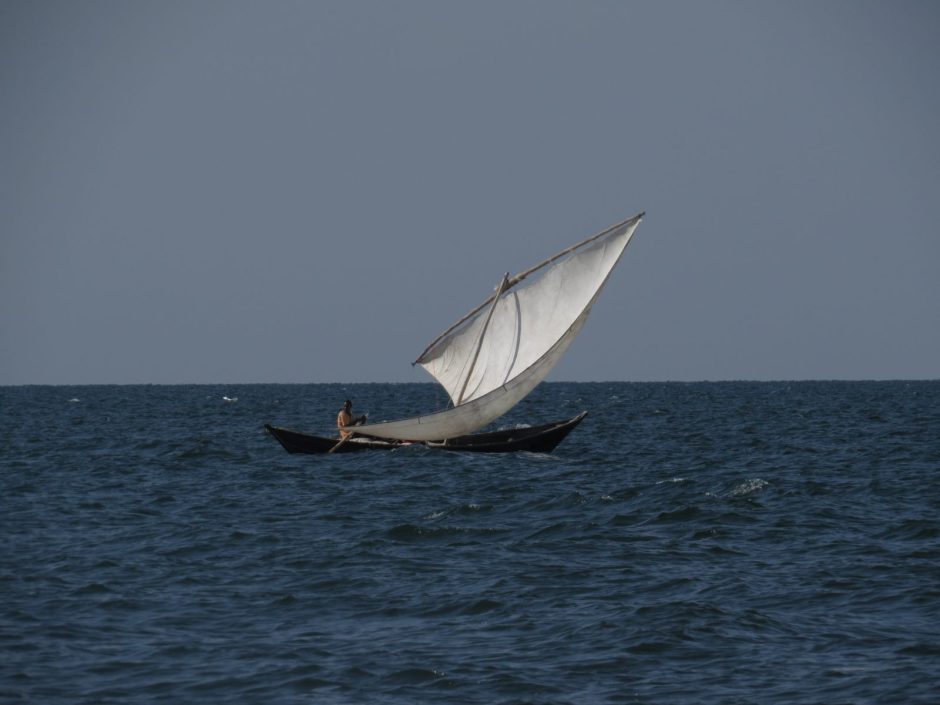
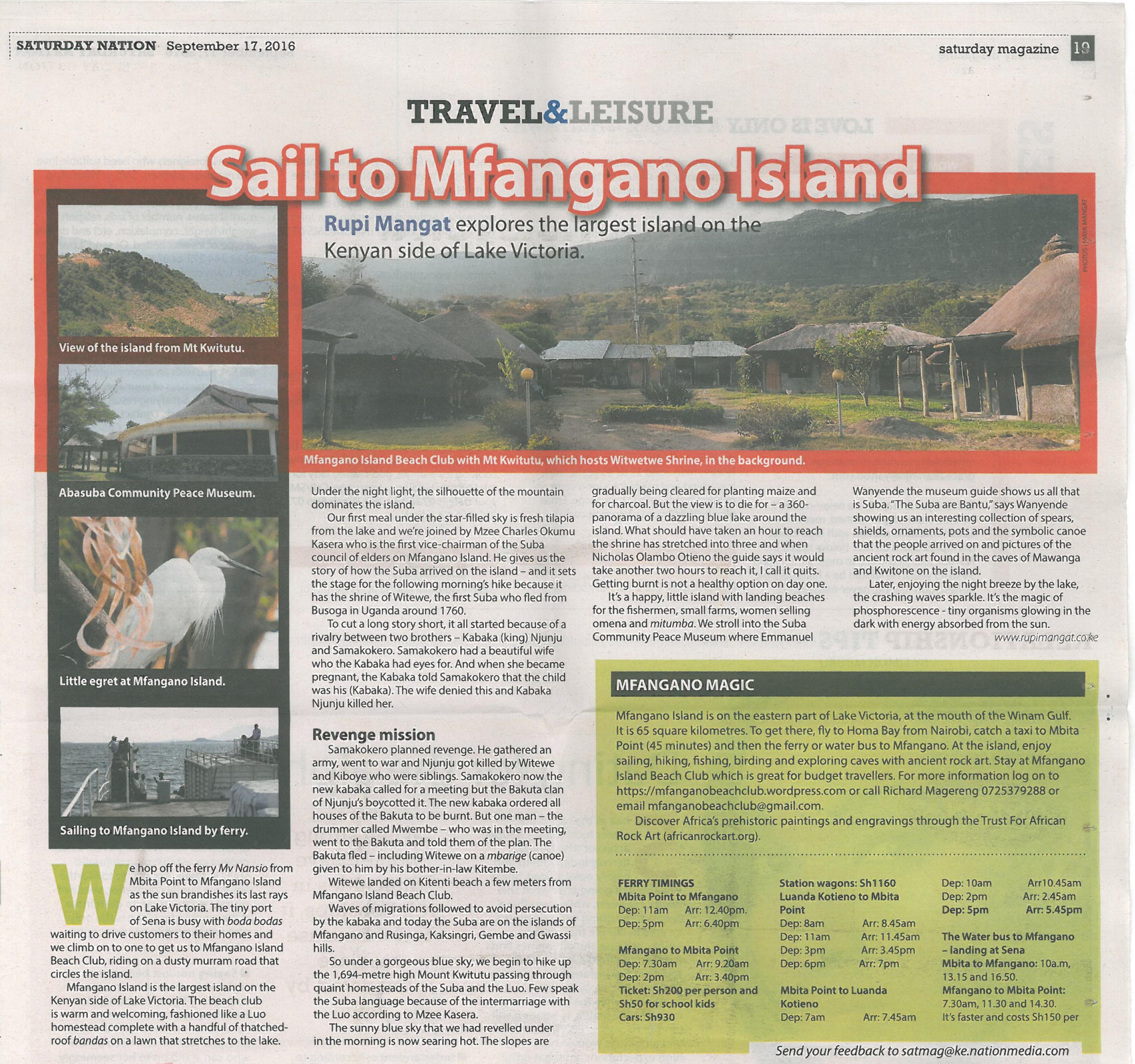
Epic Encounter with the Mountain Gorillas of Rwanda

In Volcanoes National Park, 31 August 2016

This slideshow requires JavaScript.

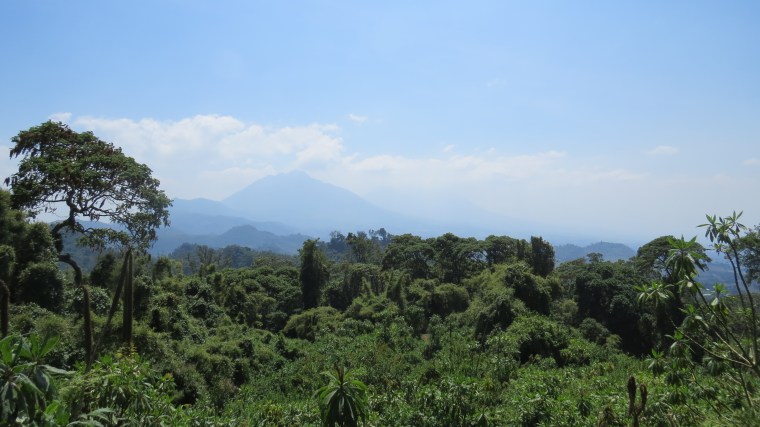
In the first light of dawn, the volcanoes of the Virunga Mountains line the skyline of Musanze, Rwanda’s second largest town in the north. The mountains share borders with Uganda and the Democratic Republic of Congo (DRC). It’s simply breath taking.

We’ve driven 100 kilometers out of Kigali, the capital at 5 a.m. to make it for the start of the trek into the forests of the volcanoes in search of the Mountain gorillas that the outside world first got to know of in the 20th century when the German explorer Captain Robert von Beringe saw them on the ridges of the volcanoes on 17th October 1902.

Hiring boots and rain coats at Volcanoes National Park in the tiny town of Kinigi, we listen intently to the gorilla ranger about the family we hopefully will meet in a few hours – it’s Amahoro meaning peace in Kinyarwanda.

And then the journey begins with a 45 minute drive up winding roads through rural farmlands on the slopes of the park. My heart skips a beat when the ranger points to the sky-scraping peak of the volcano we are to scale – but the lure of seeing a gorilla is great. Fewer than 900 880 survive in the wild on the entire planet – and their only home is the Virunga mountains.

img_6130

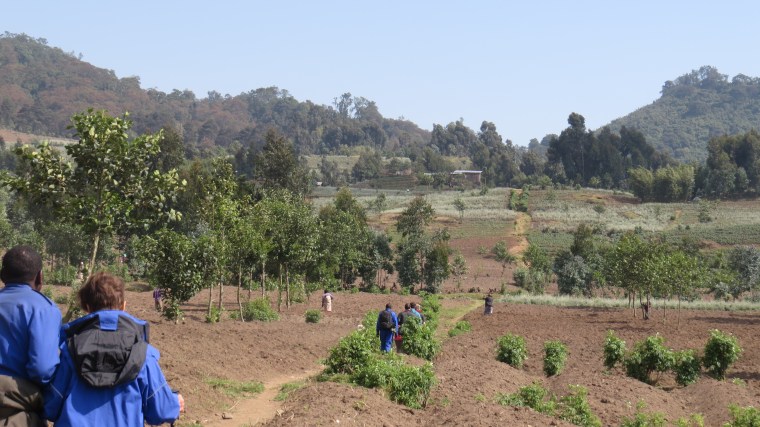
The trek begins through fields of wheat, white pyrethrum flowers, Irish potatoes and eucalyptus trees with farmers tilling to their crops and morning greetings. At the edge of the farmers’ fields, we hop over a stone wall that is the boundary between the farms and the forests of the gorillas.

The search is on. The mountain path narrows, gets dense and steep with fat forest trees, scrub, stinging nettle and tall bamboo fronds. Hours stretch to three. Panting for breath, Boniface Nzanzabandi my porter takes my hand to help with the steep incline up to a crater in the midst of the mountain. The gorilla trekkers are in there with the gorillas. An hour later, Rwambibi Leonard a gorilla tracker surfaces from the dense forest crater to guide us down and on the crater floor, stopping to catch my breath, there’s a faint rustle in the bush.

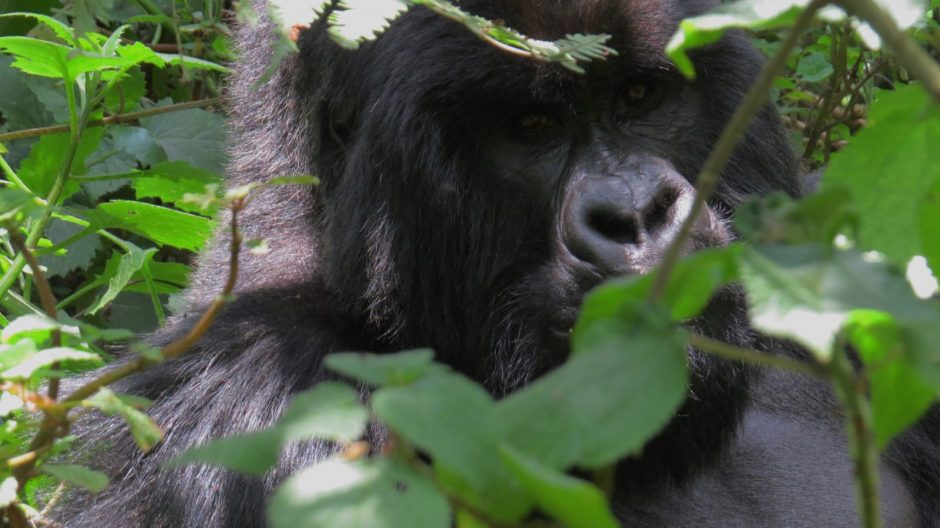
And l’m looking at a Mountain gorilla emerge from the dense forest. In that one moment, everything stops for me. It’s just me and the great ape.

“He’s 27 years old and weighs almost 200 kilograms,” tells Bahizi Edward the Rwanda Development Board tourist guide. The Silverback (adult males have white hair on their back and hence the name), is half my age and four times my size. Our eyes meet and l think, this is all that is left of his world – and l want it safe for him as l want for our children and generations to follow. His name is Gahinga.

The rest of the family follows, black flurry creatures on all fours – playful teenagers, infants and adults. Before the trek we’ve been advised not to talk, to keep a distance of a few feet, not to touch them or interfere with them and if the gorilla comes towards you in a mock charge not to run but to crouch in a ball.

img_6179

For an hour we watch mesmerized as little gorillas climb and swing playfully from forest vines, teenagers chase each other, roll around and thump their chests while Neserwa the female nurses her three-month-old infant named Mafubo meaning someone who has an excellent character at the 12th Kwita Izina gorilla baby naming ceremony the day after on 2nd September at Kinigi. The Silverback sits, chews a stalk and lumbers away. It’s hide and seek as the troop appears and disappears in the jungle.

Then the Silverback thumps his chest and ambles across the grass patch. We watch him. For some reason he changes his mind and diverts a little. The six in our group step aside quickly. Maya and l are slow. He ambles towards us and with a little nudge of his bum, topples us over and walks away as the guards help us up.

The hour’s over before we know it and we’re ushered out of the crater and down the volcano to a world out of reach for the great apes.

img_6143

Gorilla Gossip

Log on www.kwitaizina.rw

Rwanda gorilla conservation is a success story. From 400 surviving 40 years ago, there are 880 and growing today. The government’s goal is to have it off the Critically Endangered list that’s one step away from extinction in the near future. At the 12th Kwita Izina ceremony 22 baby gorillas were named.

Volcanoes N.P. – home to five of the eight volcanoes of the Virunga Mountains (KarisimbiBisokeMuhaburaGahinga and Sabyinyo). It borders Virunga National Park in the DRCo and Mgahinga Gorilla National Park in Uganda. Dian Fossey who spearheaded gorilla conservation is buried in Volcanoes N.P.

Flights to Rwanda are affordable but save up for the gorilla permit which is USD 750 per person non-refundable. Read more on http://www.rdb.rw

Rwanda is a tiny, mountainous country at 26,337.6 square kilometers compared to Kenya’s 581309.9 square kilometres. The infrastructure is fantastic, no plastic trash in sight.