Unsung heroes and little-known, spider-woman Grace Kioko compiles the first checklist of Kenya’s rich cache of spider species and their lifestyles
Above: Golden Orb Weaver Spider. The female is five times larger than the male. Courtesy Grace Kioko
Published: The East African Nation magazine 30 Oct – 5 Nov-2021
Grace Kioko is Kenya’s veritable spider-woman. She may not wear the fictional Spider-woman’s brazen skin-tight leotard with wings to fly around to save earthlings, but she’s on course to save the unsung heroes of the universe – the spiders.

Grace Kioko at Graduation ceremony from the University of Chinese Academy of Sciences
In a fascinating presentation at Nature Kenya, Kioko reveals the little-known world of Kenya’s 805 species that have been documented to date. Many more may be recorded from now on, taking into account that she is the author of Kenya’s first check list of spiders.
Kioko, a research scientist in the Zoology department at the National Museums of Kenya, graduated from the University of Chinese Academy of Sciences in 2019 with a Master’s degree in Ecology.
Spiders
Of the documented 805 species of spiders in Kenya, 300 wear the tag, ‘only found in Kenya’ which in scientific parlance means ‘endemic’. Spider species around the world number 49,713 to date.
That spiders are not insects is well known because they have eight legs. That spiders have two to eight eyes may not be so known. That you can ID a spider from its eye pattern may be even less known and that you can tell the sexes from the palp. Males support the two palpal bulbs – also known as genital bulbs, borne on the last segment of the front ‘limbs’ to transfer sperm to the female. They appear in the male after the final moult and are also useful to identify the species of the spider. But who is seriously going to that extent save for spider-lovers with microscopes. And that people do have a serious spider phobia known as Arachnophobia, some so intense that the spider is seen as a threat to one’s life.
Yet only 30 out of the 805 species of Kenya’s spiders known to date are venomous. So you are quite safe except for a painful bite. This includes the enormous hairy tarantula whose venom is too mild to kill a human.
Moreover, not a single species of spider is poisonous so you can eat them. Like the Cambodians. Fried spider is a popular dish that Gordan Ramsey has cooked and eaten and many tourists have it on their ‘to do’ list in Cambodia. But even for the Cambodians, spiders were not on the menu until the repressive rule of the Khmer Rouge between 1975 and 1979. Food was in short supply and people started eating the palm-sized spiders out of desperation. Today it’s a money-minting item, that Cambodians even breed them for the palate.
Spinning a Web
Perhaps the spider’s trademark is its web spun of silk, a natural fibre made of protein from its internal organs, strong and flexible and spun into fibre by the spinnerets on the spider’s abdomen. Who cannot stop to marvel a web spun between twigs, branches and even grass with the morning dew strung like diamonds on the fibres?
So we learn from Spider-woman Kioko that besides the eyes giving away the ‘kabila’ of the arachnida (a classification of joint-legged invertebrate animals that include scorpions, ticks and mites), spiders can be identified from the spin of the web – orb, funnel, shaded or mesh – and that they have hunting techniques and food preferences.
Some lay traps for the prey while others spin strong webs to trap the prey and when disturbed, the spider rushes to devour it. There are spiders that eat small fish while others prefer butterflies. The digestive enzymes help digest the food.
Even more bizarre is that some spider species mimic other animals to avoid being preyed upon. There is one that morphs into a ladybird and another that looks like an ant. The predators dread these animals in the wild because they taste awful.
And people see spiders as nothing special. It’s time to change perceptions.
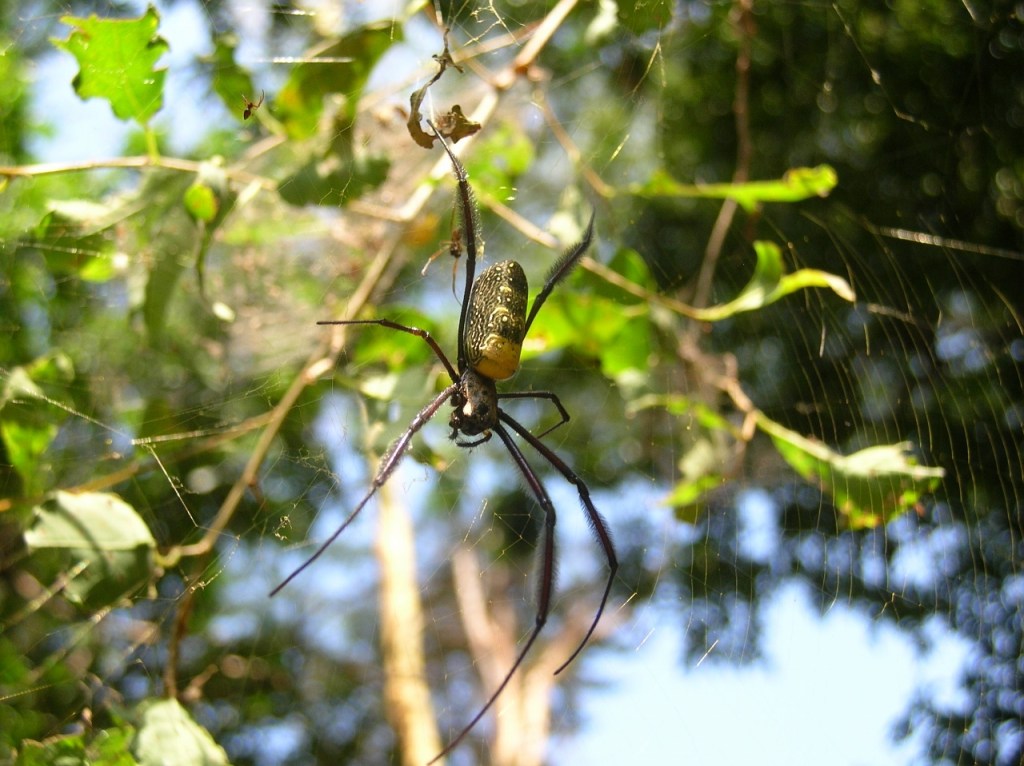
Golden Orb Weaver Spider. The female is five times larger than the male. Courtesy Grace Kioko
The Importance of Being a Spider
“If spiders disappeared, we would face famine,” said Norman Platnick of New York’s American Museum of Natural History, making a case for spider conservation. The late Platnick who died at age 68 in 2020 from injuries sustained from a fall, was in the eyes of every spider fan – the original Spider-man.
Platnick was curator emeritus of the division of invertebrate zoology for the American Museum of Natural History in New York, which holds the world’s largest spider collection. He added 158 genera and 2,023 species to the taxonomic database, and helped expand the known world of spiders to 48,000 species. Until 2014 he was also the maintainer of the World Spider Catalog, a website formerly hosted by the AMNH which tracks the arachnology literature, and attempts to maintain a comprehensive list, sorted taxonomically, of every species of spider which has been formally described. He is commemorated in the names of 8 genera and over 50 species of invertebrates.
“Spiders are the primary controllers of insects,” continues Kioko, after quoting the late Spider-man. “They eat the pests that would otherwise eat all our crops.” If all farmers appreciated this free pest-control service, it would save them money from buying pesticides which with constant use end up in our digestive system and that of other animals. It would also save the soil from being contaminated from the chemical pesticides.
Spiders eat anything and in times of no food, can survive starvation. They can also prey upon each other. In our homes, they prey upon cockroaches, mites and ticks. It sounds like we should welcome them with open arms.
Spiders are also of great economic importance other than being natural pest controllers because the spiders silk has value.
Darwin’s bark spider only discovered in Madagascar in 2009 produces the largest known orb webs, ranging from 900 to 28,000 square centimetres. Its silk is the toughest biological material ever studied. Yet the people of Madagascar have been weaving a beautiful textile from the golden orb spiders for centuries including a unique golden cloth, where 70 people spent four years collecting golden orb spiders from telephone poles in Madagascar. The fabric was displayed at the American Natural History Museum in New York in 2009.
Today, the spiders’ silk is used in medicine for repairing ligaments and tendons including in dentistry, The fibre is also used in bullet-proof best and to improve air-bags inside vehicles.
Like all wildlife, spiders face the same challenges such as habitat loss and poisoned by pesticides. According to Kioko, six species of spiders in Kenya are threatened.
So next time you see a spider in the kitchen, leave it alone. Let it hunt the mosquito.
 Moonlion Safaris