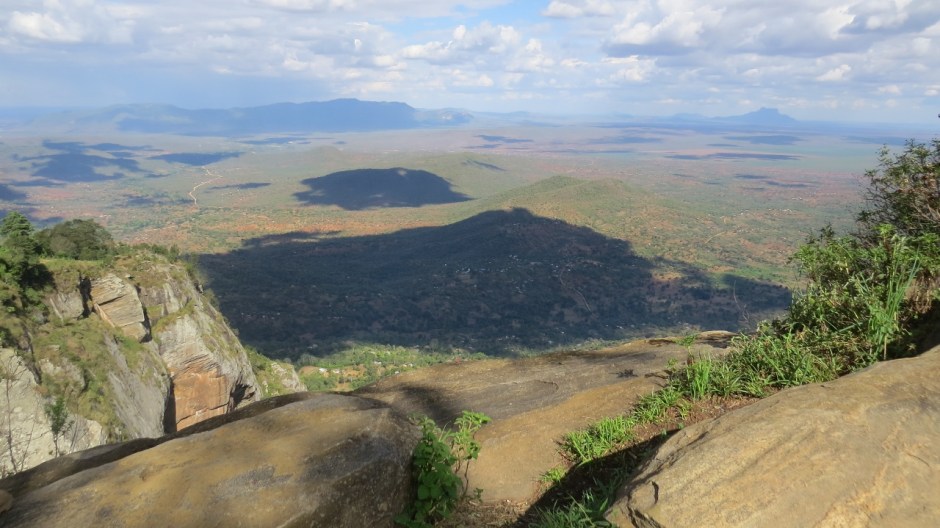
Above: Plains of Tsavo from the Mwachora Hill. Copyright Rupi Mangat
Published: 15 June 2019
The road from the peak of Ngangao that is part of the magical Taita Hills loops steep into the plains of Tsavo with amazing views of the solitary massifs of Sagalla and Kasigau. I’m taking a break from hiking to discovering the tastes and tales of Taita.
I’m full of respect for the pikipiki having reached Mwatate safely. It’s the town on the flat lands at the junction of the historical road that was action-packed during the WW1 fought between British East Africa (Kenya) and German East Africa (Tanzania).
Kasigau mountain from Mwachora Hill. The area was a battlefield during WW1. Copyright Rupi Mangat
Above: Outside the Communist Cave on Charles Miekenyi Mwakio’s farm that houses Kenyatta Caves – in Taita Hills. Copyright Rupi Mangat
I’ve hired a piki-piki for the day in the Taita Hills, the ancient crystalline massifs that date before the age of the dinosaur – between 290 and 180 million years ago. The dinosaurs came in 252 million years ago and lasted until 60 million years ago.
Ngangao forest in Taita Hills – copyright Rupi Mangat
Starting out from Ngangao forest that is the largest patch of the indigenous forest on the Taita Hills measuring 1.9 square kilometres, the plan is to visit a cave l’ve been very curious about: Kenyatta’s.
I have little fingers running through my hair sitting by Lake Ol Bolossat in central Kenya. First it’s the girls returning from school who are surprised to see me standing in the field near their village. A smile and a ‘hi’ gets them closer. After a few minutes of checking me out, they open up with questions like ‘what is your name?’, ‘where are you from?’ They find it strange when l reply l’m Kenyan. “But you are not black,” says one.
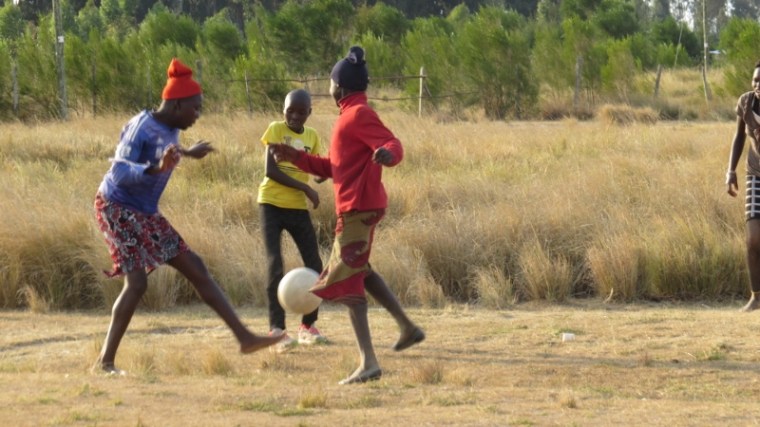
Korongo girls’ fotball team at Lake Ol Bolossat Copyright Rupi Mangat
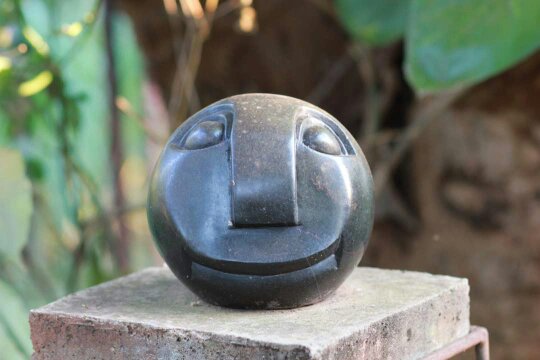
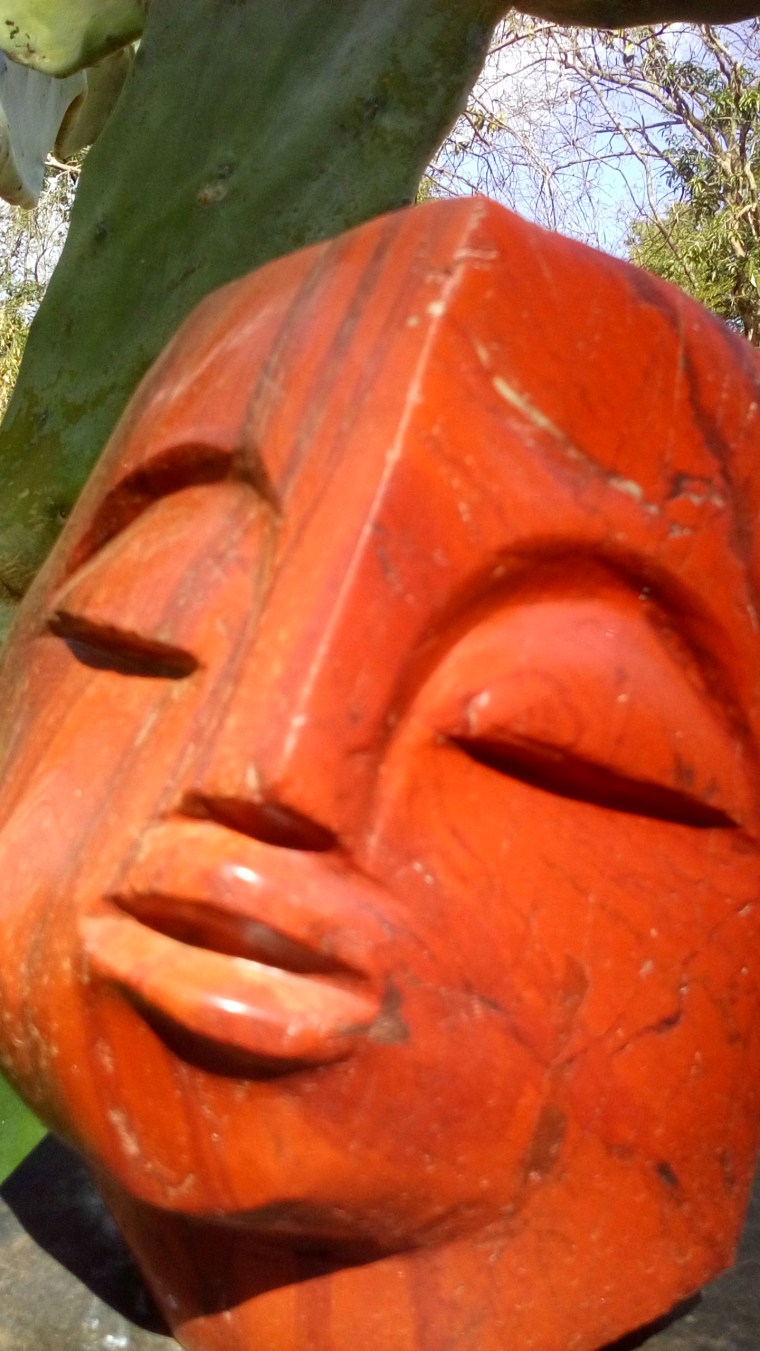
Above: Stone Sculpture from Zimbabwe. Courtesy: Carola Rasmussen
Published: 4 May 2019
Tucked away near Malindi’s powdered white beaches and tropical blue waters that are more famous for sun worshippers and ocean sports including all the sharks, whales and dolphins that swim by, l’m in a garden that’s an open art gallery of the most amazing sculptures from Zimbabwe. Strolling around l learn more of the country and its art.
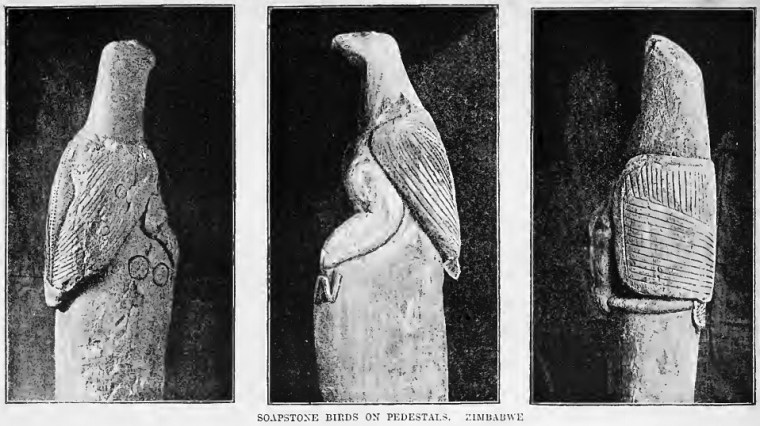
The most famous of Zimbabwe’s stone sculptures are the Zimbabwe stone birds that are the country’s emblem.
Soapstone birds on pedestals by James Theodore Bent
House of Stones
“Zimbabwe is the Shona word for ‘house of stones’,” tells Carola Rasmussen, a former journalist turned art collector where her garden gallery in Malindi is called Ndoro showcasing more than 300 stone sculptures.
“Ndoro (in Shona language) is a spiral sea shell that washes up on the East coast of Africa. It’s grinded flat. Local women healers wore it on their forehead,” explains Rasmussen. It was also worn by chiefs, their wives and daughters as symbols of authority.
Carola Rasmussen at Ndoro in Malindi
“When the Portuguese came in the 16th century, they noticed the ndoro. They then made them in porcelain back home and returned with them to exchange them for gold, ivory and other items. Today they are collector’s items.”
Her collection of stone sculptures has many pieces from the first generation of 20th century Zimbabwean artists, none of who had any formal education in the arts which makes their work even more intriguing. They are based on local legends and the spirit work.
Legacy
Zimbabwe’s stone sculptures date from 500 years ago.
The most famous of these are the Zimbabwe birds found in the ruined city of Great Zimbabwe built in the 11th century and inhabited for the next 300 years. When first reported to the outside world in the 16th century by the Portuguese explorer Joao de Barros, it was one of the world’s most extraordinary finds that still baffles many.
The elaborate stone buildings were built using no cement.
The Zimbabwe birds were only seen in the city by a European hunter, Willi Posselt in 1899 and many taken away. They were positioned around an altar in the centre of an enclosure.
Post- Colonial Stone Sculptures
Contemporary Zimbabwe stone sculptures: Carola Rasmussen at Ndoro in Malindi
In contemporary times, the sculpture movement also known as the Shona sculpture movement took the art world by storm because critics and art collectors could not understand how this art had emerged in an area that was seen as artistically barren unlike the great sculptural heritage of West Africa. The emergence of the Shona sculpture movement was coined an art renaissance and a phenomenon.
During Mugabe’s regime the art world suffered but now a younger generation of artists hopes that foreign gallery owners and tourists will return.
I never imagined l would learn so much about Zimbabwe in Malindi but art is universal. So enjoy your days exploring Malindi besides enjoying its tropical beaches and warm ocean waters, scuba diving, snorkelling and exploring historical sights.
A Dozen and more things to see in Malindi Town
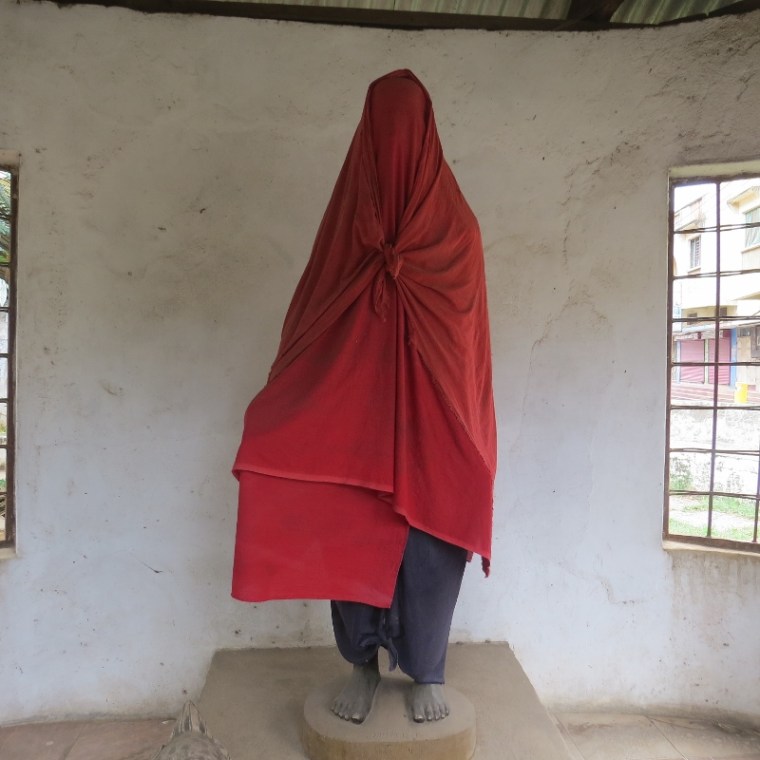
Mekatilili wa Menza, the fiery crusader against colonial rule. Statue in Malindi town square Copyright Rupi Mangat
Statue of Mekatilili wa Menza, the fiery heroine who led the Giriama community in a rebellion against British colonial rule in 1913-1918. She died in 1924 and was buried in the Dakatcha woodlands outside Malindi. Dakatcha woodlands is home to Hell’s Kitchen, a series of eroded gulleys and home to rare birds like Clarke’s weaver and the Sokoke scops owl.
Henry the Navigator’s monument
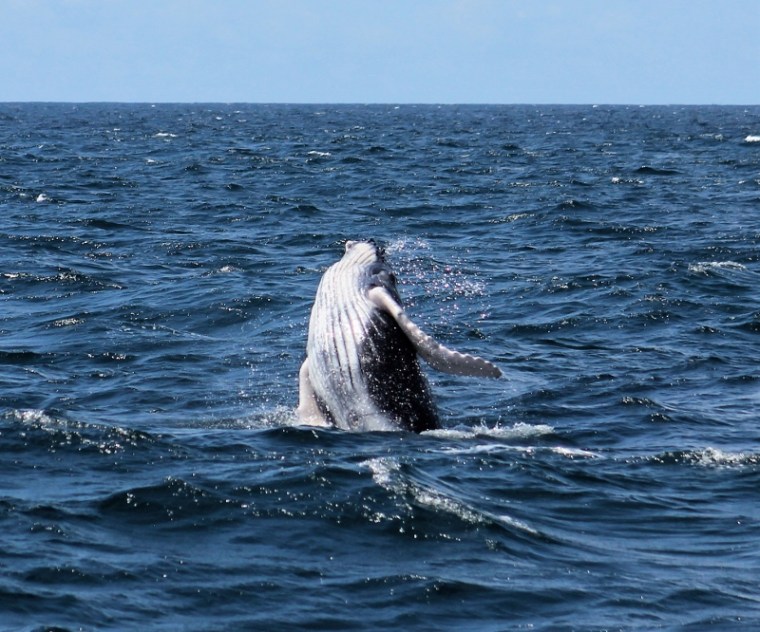
Humpback whale in Watamu, Kenya coast, Indian Ocean, doing its back flip Copyright Jane Spilsbury/Watamu Marine Association
It’s on the grounds of Malindi National Museum. It was unveiled in October 1960 by the Portuguese consul in Mombasa to honour the prince 500 years after his death in 1460. The monument also honours the Sultan of Malindi and Ahmed Ibn Majid, the local Malindi marine pilot who navigated Portuguese explorer Vasco da Gama on the sea route to India.
Vasco d Gama pillar and the quaint makuti-thatched Portuguese Chapel commissioned by Vasco Da Gama the Portuguese explorer in 1498 on his epic voyage to India via Malindi. He was the first European to do the route.
The century-old House of Columns near the church that served as a palatial home, hospital and museum and now a library.
Malindi Sea Fishing Club – Malindi is the best place for deep sea fishing. The season runs from July till March. It’s one of the few spots in the world where anglers can try their hand at a Grand Slam (three different billfish a day), a Super Grand Slam (four different billfish in a day), and a Fantasy Slam (five different billfish species in one trip). The billfish are Black, Blue and Striped Marlin, Sailfish and Broadbill Swordfish.
Best Beach – stretching all the way to the Sabaki River and the towering sand dunes of Malindi.
Malindi Golf Club – a charming club by the seafront with a rare cycad and baobab by the fairways.
Published: The East African Nation magazine 20 April 2019
The fastest growing sector in tourism now is birding. With an estimated eight million American bird watchers looking for new vistas to fly to in search of the feathered kind, East Africa is a top destination. Then there is the rest of the world with a few more million birders.
The Rwandans and Ugandans have tapped into this figure and are investing in training guides including women guides. Both countries have their respective chapters: launched Rwanda Women Birders and Uganda Women Birders in 2013 to draw in the other half of the population.
Following hot on the heels is Kenya with the launch of the Kenya Women Birders on 29 March 2019.
“The reason for launching a chapter for women is because despite having really top-rated women birders in Kenya, when it comes to bird guiding, there are very few,” explained Washington Wachira of Cisticola Tours who joined hands with the Uganda Safari Guides Association (USAGA) to kick-start the Kenyan women birders.
“Cisticola Tours will host the Kenya program to train professional bird guides. The plan is to have an East African group of women birders who can lead birding tour groups and research groups.”
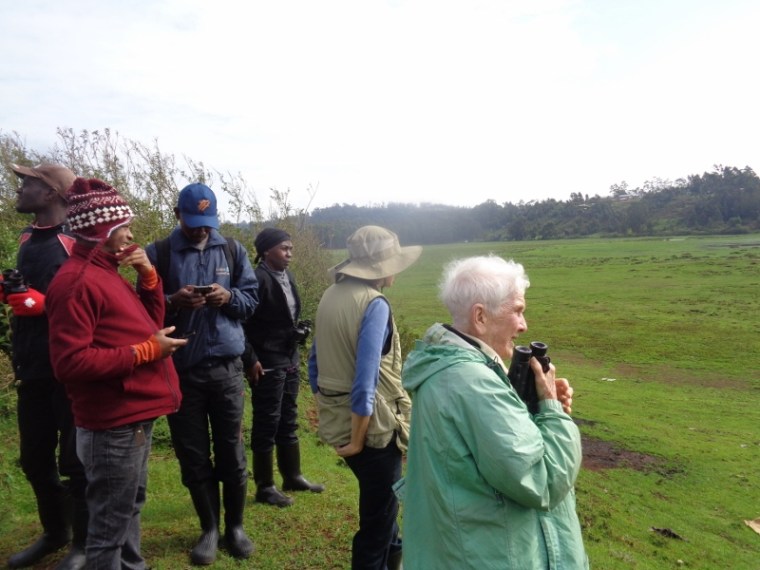
Fleur Ng’weno in green jacket who has started bird walks in Nairobi in February 1971 and still at it – Manguo Swamp March 2018 Copyright Rupi Mangat
Fleur Ng’weno the widely acclaimed top Kenyan woman birder was at the launch and honoured for her work in birding. At 80 she stills leads the bird walks every third Sunday of the month and the weekly Wednesday morning walks she has done since 1971 – 48 years ago. Almost every bird guide in the country has passed through Fleur’s ‘school of birding’.
Opportunities
“There are many opportunities that arise through birding,” quipped Fleur at the launch. “In Kenya, we now have Site Support Groups in many parts of the country.”
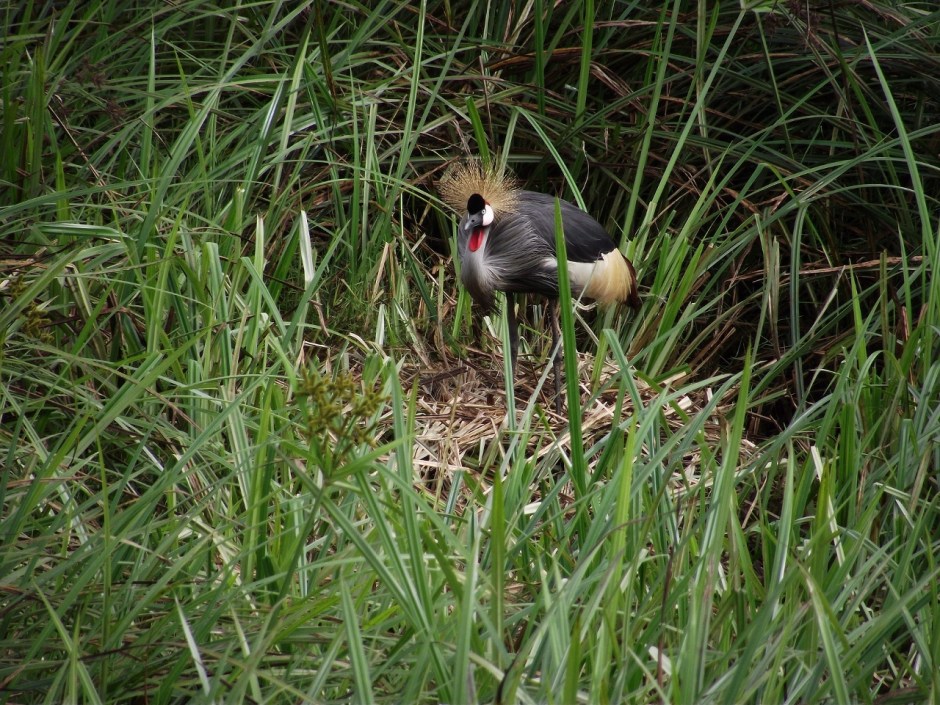
Site Support Groups under the umbrella of Nature Kenya (East African Natural History Society) are a spin-off from the bird walks in Nairobi. The local groups guide visitors and monitor the birds, rare and endemic like the Clarke’s weaver in Kilifi, Papyrus Gonolek along Lake Victoria’s shores and Grey crowned cranes at Lake Ol Bolossat.
“Birders come for many days in search of the birds they want to see,” remarked Herbert Byaruhanga of USAGA. Rare and endemic birds means patience and a stay of more than a night.
In Uganda, women birders now own tour companies, hotels and support community projects. “When you empower a woman, you empower the whole community,” remarked Lilian Kamusiime owner of Kigezi Biota Tours Ltd based in Kabale town which she started in 2013 and is a driver-guide herself. She was once a teacher.
“As a female tourist driver, yes I have encountered difficult moments like when I went to pick up seven clients from Kigali (Rwanda),” continued Kamusiime. “They were not expecting a lady guide – and they were all women from overseas.
“Anyway, it was the best trip ever for the clients. When they flew back, the leader wrote on her facebook for the 2018 International Women’s Day that I was among the best women to celebrate because I did my job as well as any other best male guide.”
Challenges
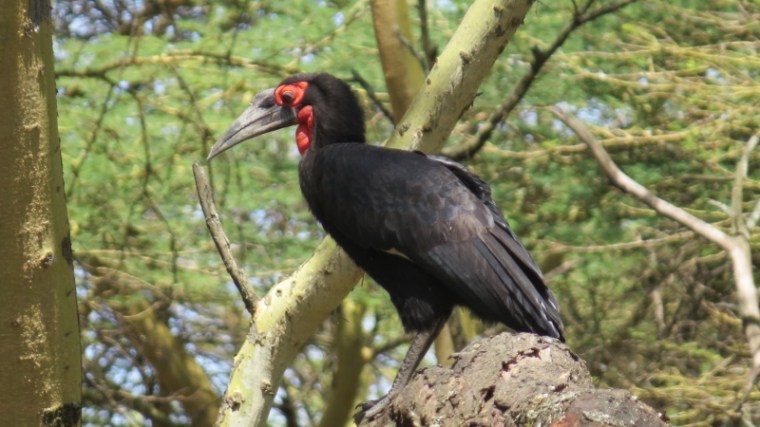
Ground Hornbill rarely seen on a tree at Lake Naivasha KWS ground Copyright Rupi Mangat
But the challenges are there for women. “I’ve had to deal with safari drivers who don’t take women guides seriously,” stated Jennifer Oduori, a protégé of Fleur and amongst the top rated bird guides in Kenya. “But you have to take a stand and show that you know what you are talking about.
“It’s the same in Uganda,” added Kamusiime. “Like most African countries, Uganda is also a male-dominated country and that was a factor why we as women had to unite to form the birders group for professional bird guides.
Research and Policy
Lilac breasted rolller Maasai Mara Copyright Rupi Mangat
African Grey Parrot -Psittacus erithacus timneh-, adult on tree, native to Central Africa and West Africa. Copyright: World Animal Protection
As an invited speaker – despite being really bad at identifying the feathered kinds – l love birding. And as a writer passionate about conservation and the environment, birds are indicators of the state of the environment. Policy makers must partner with researchers and use their data to inform the way forward on sustainable development. For when the last vulture vanishes, the crane crashes and the song bird silences, we know we’ve lost our swamps, forests, grasslands and rivers – the very ecosystems that we humans depend on.





 Moonlion Safaris